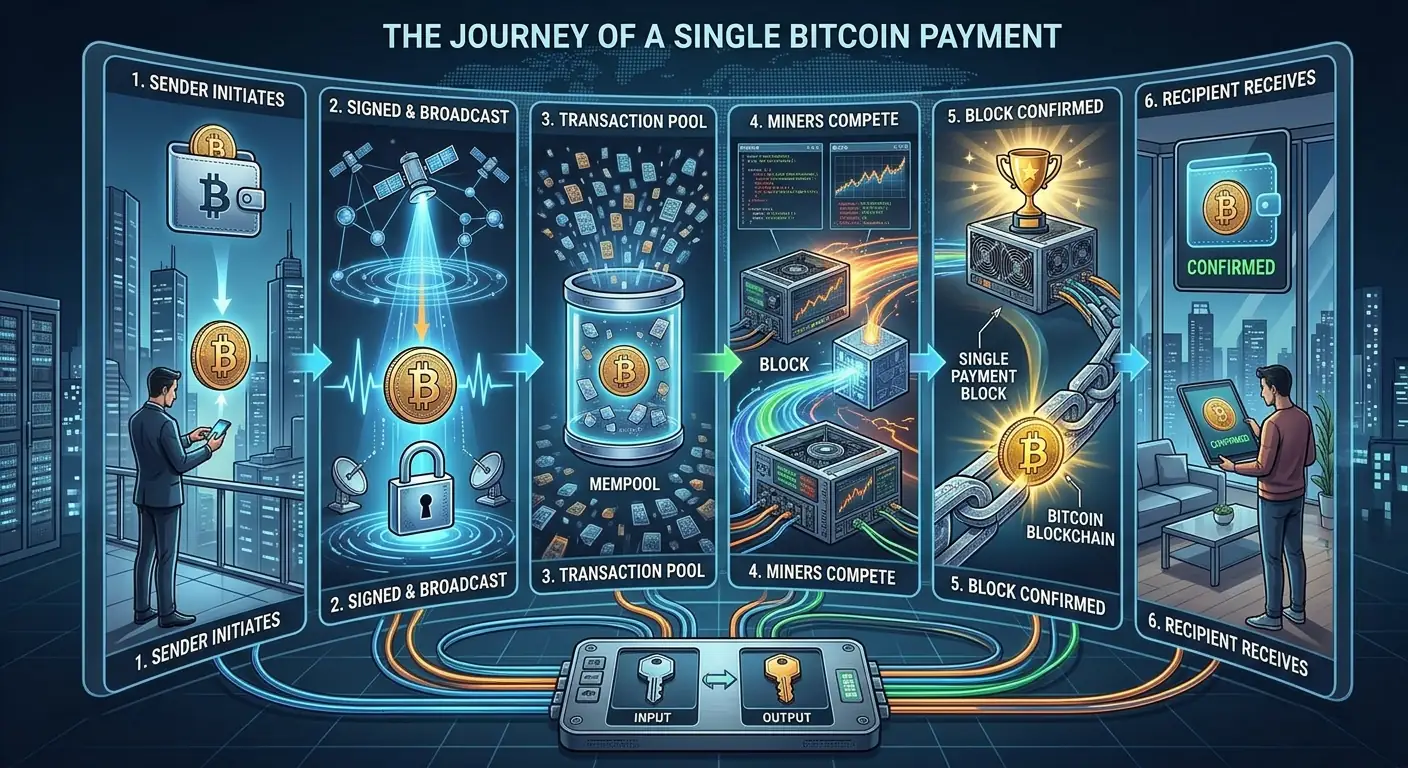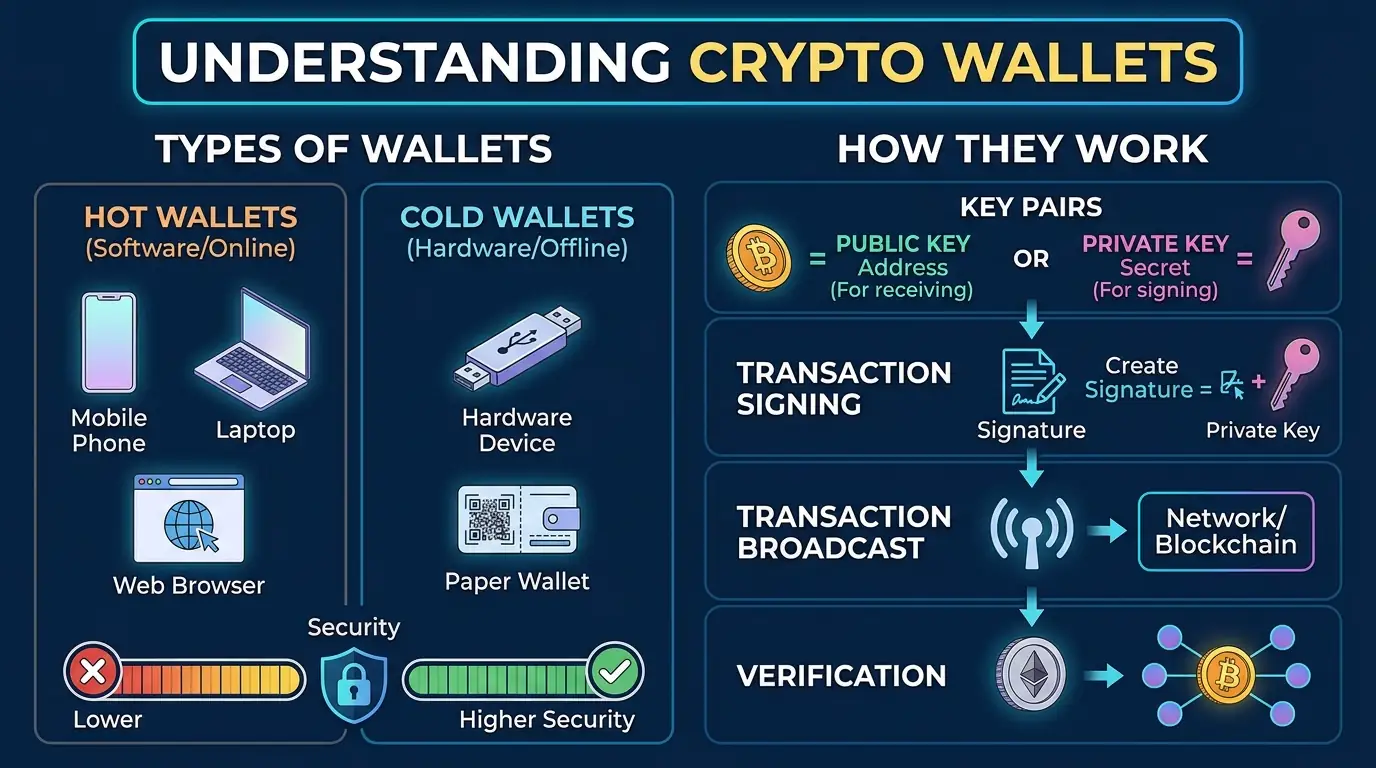
Blockchain is often explained as a shared digital notebook in which transactions are written down and stored in chronological order. It is a useful starting point, but it leaves out some of the most important parts of the technology.
A blockchain is a type of distributed digital ledger. It records information in blocks that are linked together using cryptographic techniques. Participants in the network can verify these records according to a set of rules, without necessarily relying on one central organisation to maintain the only authoritative copy.
This structure is what makes blockchain different from a conventional database. It changes how information is recorded, verified and shared.
However, not every blockchain is decentralised, completely transparent or suitable for the same purposes. Understanding how the technology works requires looking beyond the word itself.
What exactly is a blockchain?
A blockchain is a database organised into groups of records called blocks. Each block contains information and a reference to the block that came before it.
This reference is created using a cryptographic hash function. A hash function takes input data and produces a fixed-length output. Even a small change to the original information produces a different hash.
In a blockchain, this mechanism helps connect blocks and makes changes to historical records detectable.
Imagine a chain made up of numbered boxes. Each box contains a set of records and a reference to the previous box. If someone changes the contents of an older box, its cryptographic reference changes too. The links that follow no longer match.
This does not mean that altering a blockchain is mathematically impossible. It means that changing established records becomes increasingly difficult, particularly in networks where many independent participants maintain and verify the ledger.
How is a block structured?
The exact structure depends on the blockchain, but a typical block contains two main elements:
- Block header: Information used to identify and validate the block.
- Block data: The transactions or other records included in that block.
In Bitcoin, for example, the block header contains information such as the previous block’s hash, a timestamp, a difficulty target and a value called the nonce. It also includes a Merkle root, which summarises the transactions contained in the block.
The Merkle root is generated from the hashes of individual transactions, combined in a tree-like structure. It allows the network to verify that a transaction belongs to a particular block without having to reproduce the entire list of transactions in every verification process.
Other blockchain networks organise their data differently. Ethereum, for example, has its own block structure and records information associated with transactions and the state of the network.
The important point is that a block is not simply a page containing a list of payments. It also contains technical information that allows participants to verify how that block connects to the rest of the chain.
How are blocks linked together?
The connection between blocks is one of the defining characteristics of blockchain technology.
Each block references the previous block through its hash. This creates a chronological structure in which every new block builds on the history already recorded.
Consider a simplified example:
- Block 100 contains a group of transactions.
- Block 101 includes a reference to the hash of block 100.
- Block 102 references block 101.
- Block 103 references block 102.
If someone modifies the contents of block 100, its hash changes. Block 101 would then contain an incorrect reference, and the same problem would continue through the subsequent blocks.
In a network such as Bitcoin, an attacker attempting to rewrite an established part of the chain would also have to produce valid replacement blocks and compete with the work performed by the rest of the network.
The difficulty of doing this depends on the blockchain’s consensus mechanism, the resources securing it and the number of confirmations that have accumulated.
This is why blockchain records are often described as tamper-resistant rather than completely immutable. The distinction matters: the technology makes unauthorised changes difficult, but it does not eliminate every possible attack or design weakness.
Who maintains a blockchain?
A blockchain does not necessarily depend on one central server. In a distributed network, multiple computers maintain copies of the ledger and communicate with one another.
These computers are commonly called nodes.
A node receives information from the network, checks it according to the relevant protocol rules and shares valid information with other participants.
In Bitcoin, full nodes independently verify transactions and blocks. They do not simply accept whatever a miner sends them. If a block breaks the network’s rules, a full node can reject it even if a miner has produced it.
This separation is important because miners and nodes have different responsibilities.
- Nodes verify that transactions and blocks follow the protocol.
- Miners compete to produce blocks under Bitcoin’s Proof of Work system.
- Users create and authorise transactions using their wallets.
Not every participant performs every role. Someone can use Bitcoin without operating a node or mining equipment.
The arrangement also varies between networks. Ethereum, for example, uses validators rather than Bitcoin-style miners to participate in its Proof of Stake consensus mechanism.
How does a blockchain agree on what is valid?
A distributed ledger needs a way for participants to agree on which transactions and blocks should be accepted.
This is known as consensus.
Without a central authority deciding which version of the ledger is correct, the network needs rules that allow independent participants to coordinate.
Different blockchains use different consensus mechanisms. Two of the best-known examples are Proof of Work and Proof of Stake.
Proof of Work
Bitcoin uses Proof of Work. Miners compete to find a block hash that meets the network’s current difficulty requirements.
The process requires substantial computational effort. Once a miner finds a valid result, other nodes can verify it relatively easily.
The economic cost of producing blocks helps protect the transaction history. Rewriting it would require an attacker to reproduce a significant amount of computational work and overcome the work performed by the honest network.
Proof of Work is not free. Mining consumes electricity and requires specialised hardware, and the distribution of mining power is an important factor when evaluating network security.
Proof of Stake
Proof of Stake uses a different approach.
Instead of competing through computational work, participants called validators commit cryptocurrency to the network by staking it. Validators are selected to propose or attest to blocks according to the protocol’s rules.
The system may penalise validators who behave dishonestly or fail to meet their responsibilities. These penalties are often referred to as slashing.
Ethereum uses Proof of Stake. Its security model relies on economic incentives and penalties rather than the mining process used by Bitcoin.
Neither mechanism should be considered automatically superior in every situation. They involve different trade-offs concerning security, energy consumption, participation and network design.
Is blockchain the same as a database?
No. A blockchain is a particular way of organising and maintaining data, but it is not necessarily a better database for every application.
Traditional databases can be faster, easier to manage and more efficient when one organisation controls the information and is trusted to maintain it.
A blockchain becomes more interesting when several participants need to share records but do not want to rely entirely on one organisation to control the system.
The difference becomes clearer when comparing their main characteristics.
| Feature | Traditional database | Blockchain |
|---|---|---|
| Control | Usually managed by one organisation | Can be distributed among multiple participants |
| Data changes | Records can often be edited or deleted by authorised users | Historical changes are generally restricted or detectable |
| Validation | Controlled by the database administrator and its permissions | Governed by network rules and a consensus mechanism |
| Performance | Often optimised for high transaction speeds | Depends on the blockchain design and consensus process |
| Transparency | Access depends on permissions | Varies from public visibility to restricted access |
| Trust model | Users trust the organisation managing the database | Participants rely on the protocol and its governance |
A supermarket, for example, does not necessarily need a blockchain to manage its stock. A conventional database is usually more practical.
By contrast, several independent organisations tracking the movement of goods through a supply chain might find a shared ledger useful if they need a common record and do not want one participant to control all the information.
Even then, blockchain is only one possible solution. The organisations must consider cost, data privacy, governance and whether the technology solves a real problem.
Public, private and permissioned blockchains
Not all blockchains are open to everyone. Their access and governance models can differ considerably.
Public blockchains
A public blockchain is generally open to anyone who wants to read its records and interact with the network.
Bitcoin and Ethereum are examples of public blockchains. Users can create transactions without requesting permission from a central administrator.
Public networks can offer a high degree of transparency and broad participation. However, transaction data may be visible to anyone, which creates privacy considerations.
Public access does not mean that every activity is anonymous or that all users have equal influence over network development.
Private blockchains
A private blockchain restricts access to a specific group or organisation.
The operator decides who can participate, view information or perform certain actions. This can be useful when a business wants to share records internally or with selected partners.
However, a private blockchain may offer fewer decentralisation benefits than a public network because control is concentrated among a limited number of participants.
In some cases, a conventional database could provide the same functionality with less complexity.
Permissioned blockchains
A permissioned blockchain allows participation under predefined access rules.
For example, a group of banks might operate a shared ledger in which only approved institutions can validate transactions. Other users may have permission to consult certain records but not to modify them.
Permissioned systems can be public or private in terms of who can read their data, but their validation process is restricted to authorised participants.
The distinction is important because the term blockchain does not automatically imply that anyone can join, verify transactions or participate in governance.
What is blockchain used for beyond cryptocurrency?
Cryptocurrencies made blockchain technology widely known, but the same general principles can be applied to other types of digital records.
Some potential applications include:
Supply chain tracking
Companies can record information about products as they move between manufacturers, distributors and retailers. A shared ledger may help participants compare records and identify inconsistencies.
However, blockchain cannot guarantee that the original information entered into the system is accurate. If someone records a false delivery date or an incorrect product origin, the ledger may preserve that false information.
Digital identity
Blockchain-based systems can support ways of managing and verifying digital credentials. They may allow users to present certain information without exposing an entire identity document.
The design must still address privacy, data protection, credential recovery and the organisations responsible for issuing trusted information.
Smart contracts
Some blockchains support programmes that execute when predefined conditions are met.
These programmes are commonly called smart contracts. They can automate actions such as transferring tokens, managing digital assets or applying rules within decentralised applications.
A smart contract does not automatically understand real-world events. If it needs external information, such as a currency exchange rate or a delivery confirmation, it may depend on an external data provider known as an oracle.
Digital ownership and tokenisation
Blockchain networks can record ownership or control of digital tokens representing assets, rights or access.
Tokenisation does not automatically transfer legal ownership of a physical asset. The relationship between the token and the underlying asset depends on contracts, legal arrangements and the system responsible for recognising that ownership.
What are the limitations of blockchain?
Blockchain is useful in certain situations, but it is not a universal solution.
Scalability: Some networks have limited transaction capacity. When demand increases, fees may rise or transactions may take longer to confirm.
Energy consumption: The environmental impact depends partly on the consensus mechanism. Proof of Work networks require energy-intensive mining, while Proof of Stake networks operate differently.
Privacy: Public blockchains can expose transaction histories and behavioural patterns. Even if addresses do not display real names, activity can sometimes be linked to identifiable individuals.
Data quality: A blockchain can preserve records without guaranteeing that the information entered was correct in the first place.
Governance: Networks still need ways to handle software updates, disagreements and technical changes. Decentralisation does not remove governance; it changes how decisions are made.
Irreversibility: Correcting an error recorded on a blockchain may require a new transaction or an agreed process. The original record may remain visible.
These limitations explain why blockchain should be evaluated according to the problem it is meant to solve, rather than adopted simply because it is associated with cryptocurrencies.
Can a blockchain be changed or hacked?
The answer depends on what is meant by changing or hacking a blockchain.
Altering an old transaction in a well-secured public network can be extremely difficult. However, blockchain systems can still be exposed to attacks and failures.
In a Proof of Work network, a majority attack could allow an attacker controlling enough mining power to reorganise recent blocks or attempt double-spending. It would not automatically allow the attacker to create valid coins outside the protocol’s rules or spend coins belonging to other users without the required keys.
Other risks may come from weaknesses in smart contracts, compromised private keys, vulnerable applications or poorly designed bridges connecting different networks.
A blockchain can therefore remain technically operational while a service built on top of it suffers a serious security incident.
This distinction is particularly important in decentralised finance, where users may interact with several smart contracts and external services in a single transaction.
Why blockchain is more than a shared notebook
The notebook analogy helps explain why multiple participants can consult the same records, but it does not capture the technology’s full purpose.
A blockchain combines data structures, cryptography, network communication and consensus rules to maintain a shared record. Its design can reduce the need for a central organisation to control every transaction, although the level of decentralisation depends on the network.
The most useful question is not whether a project uses blockchain. It is why it needs one.
If several independent participants must coordinate records and verify changes without relying entirely on a single administrator, a blockchain may be worth considering. If one organisation already controls the process and needs a fast, flexible database, a traditional system may be the better choice.
Understanding that difference is more valuable than assuming every blockchain offers the same benefits.
Sources
- Bitcoin Developer Guide — Technical explanation of Bitcoin blocks, transactions, nodes and Proof of Work.
- Ethereum.org: What Is a Blockchain? — Introduction to blockchain architecture and Ethereum’s distributed network.
- Ethereum.org: Proof of Stake — Explanation of validators, staking and Ethereum’s consensus mechanism.
- NIST: Blockchain Technology Overview — Technical overview of blockchain structures, operation and applications.
- NIST: Hash Functions — Reference material on cryptographic hash functions.