A cryptocurrency wallet is one of the first tools people encounter when they start using digital assets. It allows users to receive, send and manage cryptocurrencies such as Bitcoin and Ether. However, the name can create a misleading impression.
A crypto wallet does not normally store coins in the same way that a physical wallet holds banknotes or cards. Cryptocurrencies exist as records on their respective blockchain networks. A wallet manages the cryptographic keys that allow users to access and authorise transactions involving those assets.
This distinction is important. Understanding what a wallet actually does helps users choose the right type of storage, protect their funds and avoid mistakes that can lead to permanent losses.
What is a cryptocurrency wallet?
A cryptocurrency wallet is a software application, hardware device or other system that manages the information needed to interact with a blockchain.
Depending on its design, a wallet can allow users to:
- Generate cryptocurrency addresses.
- Receive digital assets.
- Create and authorise transactions.
- Check balances and transaction histories.
- Connect to decentralised applications.
- Manage multiple cryptocurrencies and blockchain networks.
Some wallets are designed for a single network, while others support several blockchains and digital assets.
For example, a Bitcoin wallet manages information associated with Bitcoin addresses. An Ethereum wallet can manage ETH and compatible tokens, as well as allow users to interact with smart contracts.
The wallet provides an interface between the user and the blockchain. It does not necessarily contain the cryptocurrency itself.
If the wallet does not store coins, where are they?
Cryptocurrencies are recorded on blockchain networks.
When someone sends Bitcoin to another person, the transaction changes the ownership conditions associated with specific unspent transaction outputs. When someone receives ETH, the Ethereum network updates the relevant account balance.
In both cases, the network maintains the authoritative record.
A wallet reads the relevant blockchain information and uses cryptographic keys to prove that the user is authorised to perform certain actions.
Think of it as having a key to a secure storage facility. The key is not the contents of the facility. It gives you the ability to access or control them.
This analogy is not perfect, but it helps explain why losing a wallet device does not automatically mean losing the cryptocurrency.
If the user has a valid recovery phrase or another backup method, they may be able to restore access through a compatible wallet.
The important thing is not the physical device itself. It is the ability to recover and securely control the necessary cryptographic credentials.
Public keys, private keys and wallet addresses
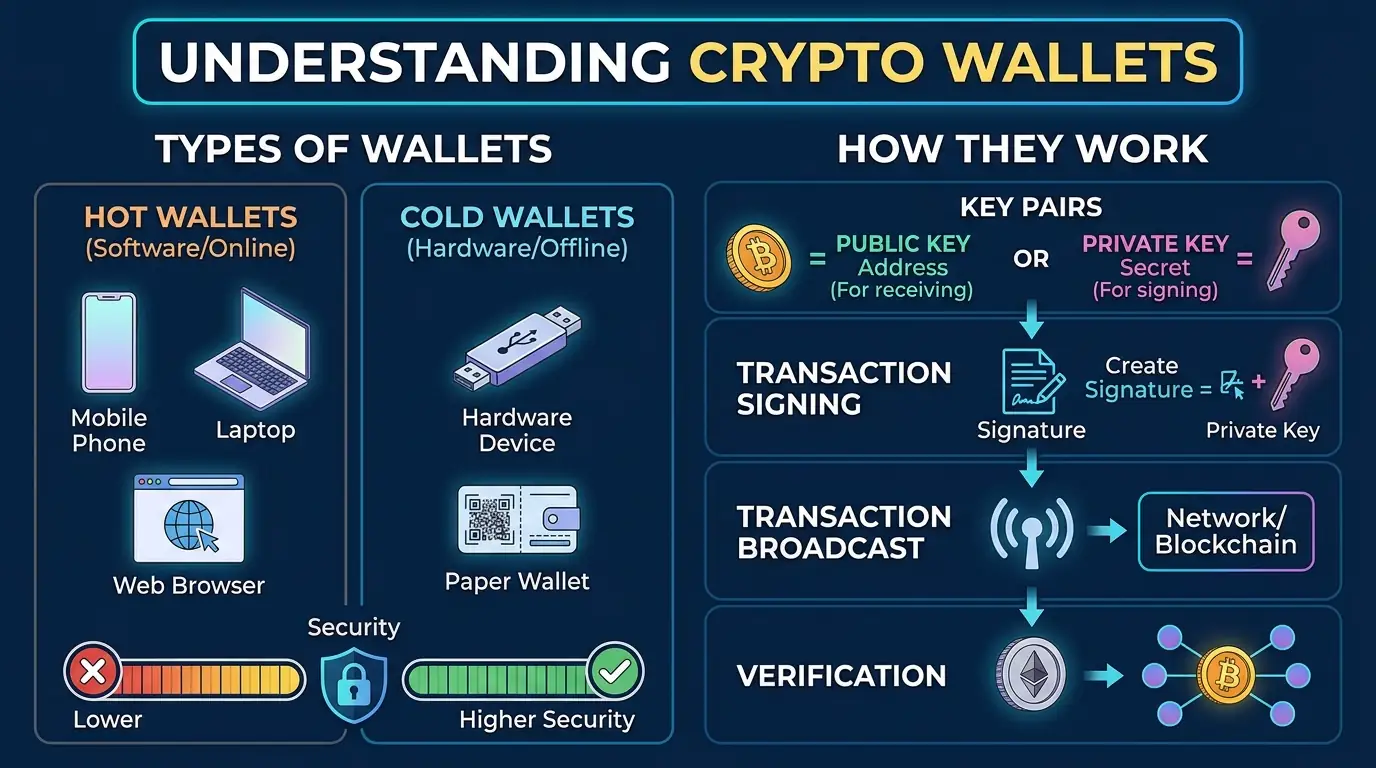
To understand how wallets work, it is necessary to distinguish between three related concepts: public keys, private keys and addresses.
Private keys
A private key is a secret cryptographic value that allows its holder to authorise certain operations.
In a typical cryptocurrency wallet, the private key is used to generate digital signatures. These signatures prove that a transaction has been authorised by someone who controls the corresponding key.
Anyone who obtains the private key may be able to move the associated funds.
For this reason, private keys must remain confidential. They should never be shared with strangers, websites or people claiming to offer technical support.
Public keys
A public key is mathematically related to a private key.
It can be used to verify digital signatures without revealing the private key itself.
Public keys are not always displayed directly to users. Many wallet systems derive addresses from public keys or related cryptographic information.
Wallet addresses
A wallet address is an identifier that can be shared with other people so they can send cryptocurrency to the appropriate destination.
It is generally safe to share a receiving address, but users should check that it belongs to the correct network and wallet.
Different blockchains use different address formats. An address that works for one network may not work for another, even when the formats look similar.
For example, Bitcoin and Ethereum addresses follow different conventions. Ethereum-compatible networks may use similar address formats, but that does not mean every token or network transfer is automatically supported by the receiving wallet.
A useful rule is to treat the receiving address as a destination identifier, not as proof that every type of cryptocurrency can be sent there.
What is a recovery phrase?
Many cryptocurrency wallets use a recovery phrase, also called a seed phrase or mnemonic phrase.
It is usually a sequence of 12 or 24 words generated when the wallet is created, although other lengths and backup methods exist.
The phrase is used to derive the wallet’s cryptographic keys. In many common wallet designs, it can recreate access to the same accounts and addresses on another compatible device.
This makes it extremely important.
If someone steals the recovery phrase, they may be able to restore the wallet and transfer its funds without needing the original device.
If the user loses the phrase and cannot access the wallet through another recovery method, restoring access may be impossible.
A recovery phrase should therefore be treated as a master backup, not as an ordinary password.
Good security practices include:
- Write it down accurately and check the order of the words.
- Keep it somewhere private and protected from damage.
- Avoid storing an unencrypted copy in cloud services or email.
- Never share it with someone claiming to be wallet support.
- Do not enter it into websites unless you are carrying out a recovery process you have independently verified.
- Consider secure backup arrangements that protect against theft, fire and accidental loss.
A legitimate support agent does not need your recovery phrase to investigate an ordinary wallet problem.
Hot wallets vs cold wallets
One of the most common ways to classify cryptocurrency wallets is according to whether their private keys are connected to the internet.
Hot wallets
A hot wallet is connected to the internet or operates in an environment where the signing keys are readily accessible to online systems.
Common examples include:
- Mobile cryptocurrency wallets.
- Desktop wallet applications.
- Browser extension wallets.
- Some web-based wallets.
Hot wallets are convenient because users can access their funds quickly and interact with online services.
For example, someone who regularly uses a decentralised exchange may prefer a mobile or browser wallet because it allows them to connect to applications and approve transactions without additional hardware.
The main drawback is exposure to online threats. Malware, phishing websites, malicious browser extensions and compromised devices can put funds at risk.
Cold wallets
A cold wallet keeps the private keys offline or uses an arrangement designed to prevent direct exposure to internet-connected systems.
Hardware wallets are a common example. They store or protect private keys inside a dedicated device and sign transactions without exposing those keys to the connected computer or mobile phone.
Cold storage can be useful for people holding cryptocurrency over longer periods or managing larger amounts.
However, it does not eliminate every risk. A user can still lose funds by revealing the recovery phrase, approving a malicious transaction or purchasing a compromised device.
The distinction is not simply that cold wallets are safe and hot wallets are dangerous. Each option has different advantages and responsibilities.
Custodial vs non-custodial wallets
Another important distinction concerns who controls the private keys.
Custodial wallets
A custodial wallet is managed by a third party that controls the private keys on behalf of the user.
Many centralised cryptocurrency exchanges offer this type of service.
When someone buys Bitcoin through an exchange and leaves it on the platform, the exchange may manage the keys associated with the funds.
The user can usually access their balance through an account, password and additional security checks.
This can be convenient for beginners because they do not have to manage recovery phrases or private keys directly.
However, they are relying on the provider.
If the exchange experiences financial problems, suspends withdrawals, suffers a security breach or restricts the account, the user may temporarily or permanently lose access to their funds.
The exact legal and operational protections depend on the platform and the jurisdiction.
Non-custodial wallets
A non-custodial wallet gives users control over their private keys or recovery credentials.
The wallet provider does not normally have the ability to authorise transactions independently on the user’s behalf.
This provides greater control, but it also transfers responsibility to the user.
If the recovery phrase is lost, the wallet provider may have no way to restore access. If the phrase is stolen, an attacker may be able to take the funds.
Non-custodial wallets are therefore not automatically safer. They remove certain third-party risks but introduce greater personal responsibility.
Comparing the main types of wallets
| Wallet type | Who controls the keys? | Internet exposure | Main advantage | Main risk |
|---|---|---|---|---|
| Exchange wallet | Third-party provider | Online service | Convenient access to trading | Dependence on the exchange |
| Mobile wallet | Usually the user | Usually online | Easy everyday use | Device compromise and phishing |
| Desktop wallet | Usually the user | Depends on configuration | More control over wallet management | Malware and computer security |
| Browser wallet | Usually the user | Online | Convenient access to dApps | Malicious websites and approvals |
| Hardware wallet | Usually the user | Designed to keep keys offline | Isolates signing keys | Device loss, recovery phrase theft or user error |
| Paper backup | User, if correctly created | Offline | Can provide an offline record of recovery information | Physical damage, theft and handling mistakes |
A paper backup is not necessarily a complete wallet by itself. It may simply contain the recovery phrase or private key needed to restore access.
Can one wallet hold different cryptocurrencies?
Some wallets support multiple cryptocurrencies and blockchain networks.
For example, a multi-chain wallet may allow users to manage Bitcoin, Ethereum and compatible tokens through one interface.
However, support for one asset does not automatically imply support for every token or network.
A wallet may display an Ethereum address while supporting only certain Ethereum-compatible networks. Another wallet may support Bitcoin but not assets issued on Ethereum.
Users should check three things before receiving funds:
- Does the wallet support the cryptocurrency?
- Does it support the specific blockchain network being used?
- Does it support the relevant token standard, if applicable?
This matters particularly when transferring stablecoins. The same stablecoin name may exist on several networks, and sending it through an unsupported network can make recovery difficult or impossible.
Why do wallet balances sometimes look different?
A wallet balance is generally obtained from blockchain data, but the way it is displayed depends on the application.
Some wallets show the total value of all supported assets in a chosen currency, such as euros or US dollars. Others display individual token balances, pending transactions or estimated values.
There may also be differences between the wallet interface and the balance shown by a blockchain explorer.
Possible reasons include:
- The wallet has not refreshed its blockchain data.
- A transaction is still pending.
- The application does not support a particular token.
- The wallet is displaying a different network.
- A token balance has not been imported or recognised.
- The displayed market value uses a different price source.
If a balance appears incorrect, users should verify the address and network through a trusted blockchain explorer before assuming that funds have disappeared.
What happens if you lose your wallet?
The answer depends on what exactly has been lost.
If someone loses a mobile phone containing a non-custodial wallet, the cryptocurrency is not necessarily lost. They may be able to restore access on another compatible device using the recovery phrase.
If they lose access to a custodial exchange account, they may be able to recover it through the platform’s account recovery process, subject to its security procedures.
The situation is very different if a user loses both the device and the recovery credentials needed to restore a non-custodial wallet.
In that case, access may be permanently lost.
This is why backing up recovery information is one of the most important responsibilities associated with self-custody.
It is also worth understanding that a recovery phrase is not the same as a password. Changing the password used to unlock a wallet application does not necessarily change the underlying private keys.
What happens if someone steals your recovery phrase?
A stolen recovery phrase can give an attacker control over the wallet.
They may be able to import it into another wallet application, generate the same accounts and sign transactions that transfer the funds elsewhere.
The original owner may not receive a warning before this happens.
If a recovery phrase has been exposed, the safest response is generally to create a new wallet with a new recovery phrase and transfer any remaining assets to it as quickly as possible, using a secure device and carefully checking each transaction.
Simply changing the password on the original wallet is not enough if someone else already has the recovery phrase.
Users should also avoid entering their phrase into online recovery websites or following instructions from unsolicited support messages. These are common methods used by scammers to steal cryptocurrency.
How should you choose a cryptocurrency wallet?
There is no single wallet that is right for everyone. The best choice depends on how often someone uses cryptocurrency, how much responsibility they want to take on and what level of security they need.
A person who makes occasional small transactions may prefer a mobile wallet because it is straightforward and convenient.
Someone who frequently trades may keep a limited balance on an exchange for operational reasons, while understanding the risks of leaving funds with a third party.
A person holding cryptocurrency over a longer period may prefer a hardware wallet and a carefully protected recovery backup.
Before choosing a wallet, consider:
- Control: Do you want to manage your own private keys?
- Security: What protection does the wallet offer against online threats?
- Compatibility: Does it support your cryptocurrencies and networks?
- Recovery: What happens if you lose the device?
- Usability: Can you understand and verify transactions before signing them?
- Transparency: Is the wallet developed by a reputable provider with clear security information?
It is also sensible to test a new wallet with a small amount before transferring larger balances.
Common mistakes when using cryptocurrency wallets
Many wallet-related losses are caused by avoidable mistakes rather than failures in the blockchain itself.
Some of the most common include:
Sharing the recovery phrase: No legitimate wallet service needs the phrase to provide ordinary technical support.
Sending assets through the wrong network: A receiving wallet may not support the network selected by the sender.
Ignoring transaction details: Some malicious applications request approvals that grant broader permissions than users realise.
Keeping everything on an exchange: Custodial services introduce dependence on the provider and its ability to safeguard and release assets.
Failing to create a backup: Losing the device without a valid recovery method can make funds inaccessible.
Trusting fake wallet applications: Fraudulent apps can imitate legitimate products and steal recovery credentials.
Assuming a wallet provider can reverse transactions: Most blockchain transfers cannot be reversed by the wallet application once confirmed.
Taking a few seconds to check an address, network and transaction details can prevent problems that may be impossible to fix later.
A wallet is a tool for controlling access, not a place where coins live
A cryptocurrency wallet does not usually hold the coins themselves. It manages the keys that allow users to interact with assets recorded on a blockchain.
That distinction explains why the device can be replaced, why the recovery phrase is so important and why losing control of private keys can mean losing access to funds.
Choosing a wallet is therefore not only a question of convenience. It is a decision about custody, security and responsibility.
Understanding who controls the keys is the best starting point for deciding how to store and manage cryptocurrency.
Sources
- Bitcoin Developer Guide: Wallets — Explanation of Bitcoin wallets, addresses and key management.
- Ethereum.org: Wallets — Overview of cryptocurrency wallets and their functions.
- Ethereum.org: Wallet Security — Security guidance for users interacting with Ethereum.
- Bitcoin.org: Securing Your Wallet — Recommendations for protecting cryptocurrency wallets and backups.
- BIP-39: Mnemonic Code for Generating Deterministic Keys — Technical specification for mnemonic recovery phrases.