Ethereum is often described as the second-largest cryptocurrency project after Bitcoin. However, this description overlooks its main purpose. Ethereum is not simply a digital currency. It is a blockchain network designed to run programmes and applications without depending entirely on a central server or company.
Its native cryptocurrency, Ether (ETH), plays an important role in this system. It is used to pay transaction fees, participate in network security and interact with applications built on Ethereum.
The key idea is that Ethereum allows developers to create software whose rules and operations are recorded and executed on a blockchain. This makes it possible to build financial services, digital marketplaces, games and other applications that operate through shared network infrastructure.
To understand Ethereum, it is necessary to look at the relationship between the network, its cryptocurrency and the programmes that run on it.
What is Ethereum?
Ethereum is a decentralised blockchain platform introduced in 2015. It was designed to extend the possibilities of blockchain technology beyond recording simple transfers of digital currency.
Bitcoin mainly focuses on maintaining a peer-to-peer payment system. Ethereum, by contrast, provides an environment where developers can deploy programmes called smart contracts.
These contracts contain instructions that the network executes when specific conditions are met. Because they operate according to predefined rules, they can automate processes without requiring a traditional intermediary to carry out every step.
For example, a developer could create a contract that allows users to exchange digital tokens according to rules established in its code. Once deployed, the contract can be used by different people through compatible applications.
Ethereum is therefore better understood as a programmable blockchain. ETH is its native asset, but the network supports many other types of digital assets and applications.
What is Ether (ETH), and why does Ethereum need it?
Ether, commonly identified by the ticker ETH, is the native cryptocurrency of Ethereum.
It has several functions within the network.
Paying transaction fees
Every operation that uses Ethereum’s computational resources requires a fee. This includes sending ETH, transferring tokens and interacting with smart contracts.
These fees are paid in ETH through a mechanism known as gas.
Supporting network security
Ethereum uses Proof of Stake. Validators deposit ETH as a stake to participate in the process of proposing and validating blocks.
The protocol can penalise validators who behave dishonestly or fail to meet certain requirements. This economic mechanism helps discourage behaviour that could undermine the network.
Transferring value
ETH can also be sent between users, held in wallets or exchanged on cryptocurrency platforms.
It can therefore function as a digital asset independently of its role in operating the Ethereum network.
It is important to distinguish between Ethereum and Ether. Ethereum is the network and its underlying infrastructure. Ether is the cryptocurrency used within that system.
What are smart contracts?
Smart contracts are programmes stored and executed on a blockchain.
They contain instructions that determine how certain operations should work. When a user interacts with a contract, the network processes the request according to the code and the rules of Ethereum.
The term can be slightly misleading. A smart contract is not necessarily a legal contract, nor does it automatically understand human intentions. It is software that executes predefined instructions.
Consider a simple example.
Imagine that two people want to exchange digital tokens. Instead of relying on a company to process the exchange, they interact with a smart contract designed for that purpose.
The contract can check whether the required conditions are met and execute the exchange accordingly. If the conditions are not satisfied, the operation may fail.
The important difference is that the rules are enforced through the network’s execution environment rather than being handled exclusively by a central service.
Smart contracts can be used for much more than token exchanges. They are also used to manage lending protocols, voting systems, digital collectibles and other blockchain-based services.
However, they are not automatically safe. A programming error or poorly designed mechanism can create vulnerabilities that attackers may exploit.
How does a smart contract work in practice?
Ethereum executes smart contracts through its virtual machine, known as the Ethereum Virtual Machine (EVM).
The EVM provides a common environment in which compatible nodes can execute the same contract code and reach consistent results.
Developers usually write smart contracts using programming languages such as Solidity. The code is then compiled into a format that the EVM can execute.
A simplified process looks like this:
- A developer writes the contract.
- The code is compiled and deployed to Ethereum.
- The contract receives an address on the network.
- A user interacts with it through a wallet or application.
- The transaction is submitted to Ethereum.
- Validators process the transaction and the network updates the relevant state if it is valid.
Once a contract is deployed, its code is generally difficult to change. Some contracts include upgrade mechanisms, but these introduce additional design and governance considerations.
For this reason, developers need to test contracts carefully before making them available to users.
What are decentralised applications?
Decentralised applications, usually called dApps, are applications that use blockchain networks and smart contracts to provide certain functions.
Unlike a conventional application that depends entirely on a company’s servers and databases, a dApp can rely on smart contracts to manage important parts of its operation.
For example, a decentralised exchange may allow users to trade tokens directly through smart contracts. A lending application may allow people to deposit cryptocurrency and borrow other digital assets according to rules encoded in its contracts.
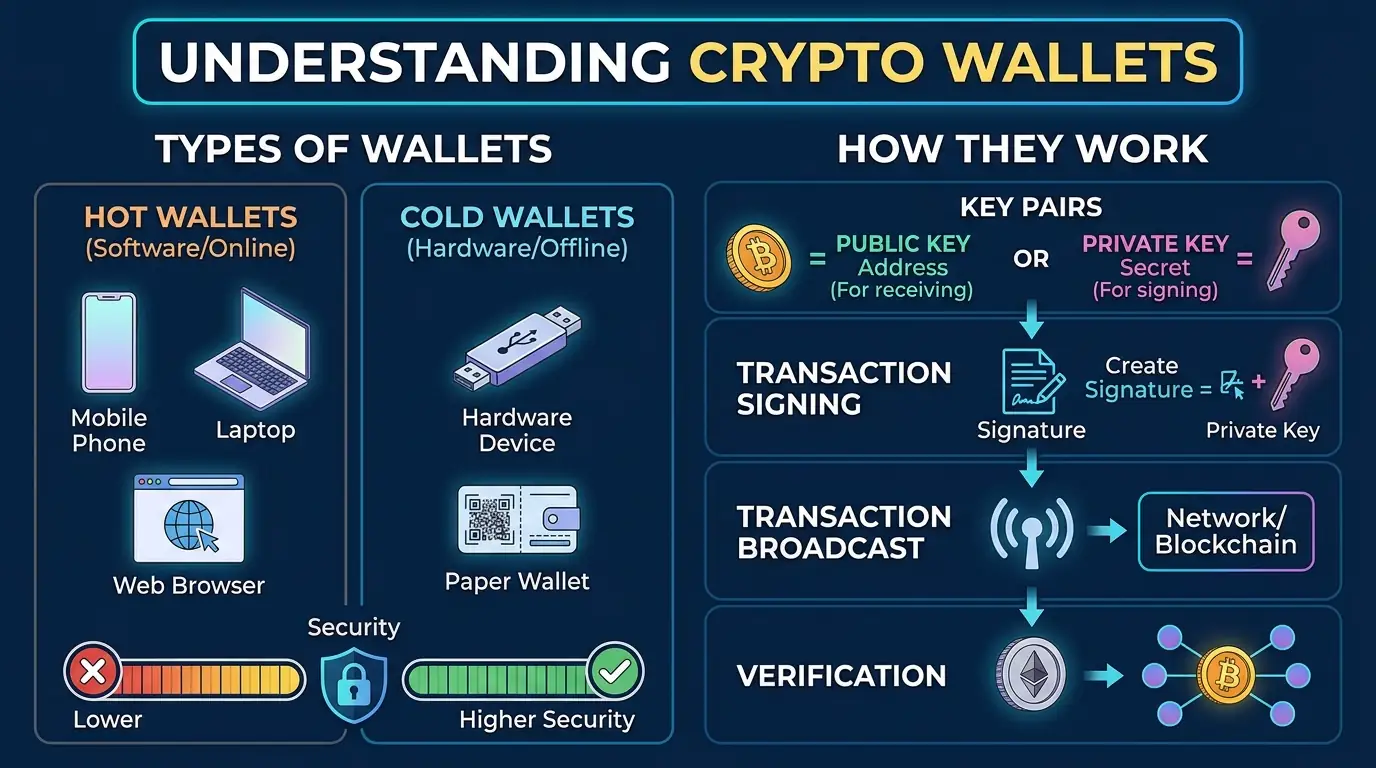
Users typically connect through a compatible wallet. The wallet allows them to authorise transactions and interact with the application.
However, not every part of a dApp must be decentralised. Its website, interface, data storage or other services may still depend on centralised infrastructure.
This distinction matters because an application can use Ethereum while relying on external companies for several essential functions.
What can people do on Ethereum?
Ethereum supports a broad range of applications. Some of the most common categories include decentralised finance, stablecoins, NFTs and blockchain-based games.
Decentralised finance (DeFi)
Decentralised finance refers to financial services built using blockchain technology and smart contracts.
These services may allow users to exchange tokens, lend cryptocurrency, borrow digital assets or provide liquidity to trading pools.
For example, someone may deposit tokens into a lending protocol. The smart contracts manage the deposit and apply the rules governing interest, collateral and withdrawals.
The system can operate without a traditional bank approving every transaction.
However, DeFi introduces risks that users may not face in the same way with conventional financial services. These include smart contract vulnerabilities, liquidation, unstable collateral, liquidity problems and malicious projects.
A decentralised protocol is not necessarily a safe protocol.
Stablecoins
Many stablecoins operate as tokens on Ethereum.
A stablecoin is designed to maintain a relatively stable value, often by tracking a currency such as the US dollar.
Users can transfer these tokens, hold them in compatible wallets or interact with applications that support them.
The fact that a stablecoin runs on Ethereum does not guarantee that it will maintain its intended value. Its stability depends on the reserves, mechanisms, issuer and redemption arrangements behind it.
Non-fungible tokens (NFTs)
Ethereum helped popularise non-fungible tokens.
An NFT is a unique token that can represent a digital item, a collectible, access rights or other forms of digital ownership claims.
Unlike interchangeable tokens such as ETH, each NFT has distinguishing information that makes it identifiable.
NFTs are commonly used in digital art, gaming and membership systems.
However, owning an NFT does not automatically mean owning the copyright to the image or other content associated with it. The rights granted to the buyer depend on the applicable licence or legal agreement.
Blockchain games
Some games use Ethereum-compatible networks to manage digital assets such as characters, equipment or in-game items.
These assets may be represented by tokens that users can transfer between compatible wallets or applications.
The practical value of these items depends on the game, its rules, market demand and whether the developer continues to support the ecosystem.
What is gas, and why do Ethereum transactions cost money?
Gas is the unit used to measure the computational work required to execute operations on Ethereum.
A simple transfer of ETH requires less computational work than interacting with a complex smart contract. Consequently, different transactions consume different amounts of gas.
The total fee is determined by the amount of gas used and the applicable fee rate.
Ethereum uses a fee mechanism that includes a base fee and, in many cases, an additional priority fee.
- Base fee: The minimum fee per unit of gas required by the network for inclusion in a block. It changes according to network demand and is burned.
- Priority fee: An optional additional amount intended to incentivise validators to include a transaction.
- Gas limit: The maximum amount of gas the user is willing to allow the transaction to consume.
For example, a user transferring ETH may pay a relatively small fee under normal network conditions. Interacting with a complex DeFi contract can require significantly more gas.
Fees are not calculated simply as a percentage of the amount being transferred. A transaction involving a large monetary value may use less gas than a smaller but more complex operation.
This is why users should check the estimated fee before confirming a transaction.
How does Ethereum maintain its network?
Ethereum currently uses Proof of Stake to secure its blockchain.
Instead of miners competing through computational work, validators participate by staking ETH. The protocol selects validators to propose blocks and other validators to attest to their validity.
Validators must follow the network’s rules. Depending on the circumstances, dishonest behaviour or certain failures can result in penalties, including the loss of part of their stake.
The system aims to make attacks economically expensive while allowing participants to verify the blockchain’s history.
Ethereum’s transition from Proof of Work to Proof of Stake took place in September 2022 in an event commonly known as The Merge.
This change substantially reduced the network’s direct energy consumption associated with consensus. It did not remove every environmental impact related to the wider Ethereum ecosystem, such as the energy used by users’ devices and supporting infrastructure.
What is the difference between Ethereum and Bitcoin?
Bitcoin and Ethereum are both public blockchain networks, but they were designed with different priorities.
Bitcoin focuses on peer-to-peer transfers of value and a monetary system with a predictable issuance schedule. Ethereum was designed to support programmable transactions and applications.
| Feature | Bitcoin | Ethereum |
|---|---|---|
| Main purpose | Peer-to-peer digital currency | Programmable blockchain platform |
| Native asset | BTC | ETH |
| Consensus mechanism | Proof of Work | Proof of Stake |
| Smart contracts | Limited scripting capabilities | General-purpose smart contracts |
| Network fees | Transaction fees based on block space and transaction size | Gas fees based on computational resources |
| Main applications | Payments and value transfer | DeFi, tokens, NFTs and decentralised applications |
| Monetary supply | Maximum supply of 21 million BTC | No fixed maximum supply, with issuance and burning mechanisms |
Neither network is simply a replacement for the other.
Bitcoin and Ethereum address different needs, and their technical designs reflect those priorities.
Does Ethereum have a limited supply?
Unlike Bitcoin, Ethereum does not have a fixed maximum supply defined in the same way.
ETH is issued to reward validators for participating in network security. At the same time, part of the transaction fees is burned, meaning that ETH is permanently removed from circulation.
The relationship between new issuance and burned fees affects the overall supply.
When network activity is high, the amount of ETH burned can increase. Depending on the balance between issuance and burning, the total supply may increase or decrease over a particular period.
This means that Ethereum’s monetary supply is influenced by network activity and protocol rules rather than a predetermined maximum number of coins.
It is important not to interpret this mechanism as a guarantee that ETH will become scarce or increase in price. Supply is only one factor affecting the market value of an asset.
What are Ethereum Layer 2 networks?
Ethereum has faced scalability challenges as demand for its services has increased.
Layer 2 networks are designed to process transactions outside the Ethereum mainnet while using Ethereum as part of their security or settlement model.
Rollups are one of the main approaches. They execute transactions on a separate layer and then submit transaction data or proofs to Ethereum, reducing the amount of work that must be processed directly on the main network.
Examples include Optimism and Arbitrum.
These networks can offer lower fees and faster transaction processing for users. However, their security properties and decentralisation levels depend on their individual designs.
Users should also understand that moving assets between Ethereum and a Layer 2 network may require a bridge or another transfer mechanism. These systems introduce additional technical risks.
What are the risks of using Ethereum?
Ethereum provides infrastructure for many applications, but interacting with the network involves several risks.
Smart contract vulnerabilities: A coding error can allow attackers to exploit a contract and potentially steal or lock funds.
Transaction mistakes: Sending ETH or tokens to an incorrect address can result in permanent loss. Not every address can receive every type of asset.
Network fees: Gas prices can increase during periods of high demand. A transaction may cost more than expected.
Scams and fake applications: Fraudulent websites can imitate legitimate wallets, exchanges and DeFi platforms to trick users into signing malicious transactions.
Token volatility: ETH and other tokens can experience substantial price fluctuations.
Application dependencies: A decentralised application may rely on centralised websites, data providers or other external services. These dependencies can create risks even when the smart contracts themselves operate correctly.
Users should evaluate both the Ethereum network and the individual applications they choose to use. A secure blockchain does not automatically make every project built on it trustworthy.
Why Ethereum is more than a cryptocurrency
Ethereum is a programmable blockchain that allows developers to build applications using shared infrastructure and smart contracts.
ETH supports this system by paying transaction fees and helping secure the network through staking. Meanwhile, smart contracts make it possible to automate operations involving digital assets and other types of information.
This combination has made Ethereum an important platform for decentralised finance, stablecoins, NFTs and other blockchain-based services.
Understanding Ethereum means looking at the entire ecosystem: the network, its native cryptocurrency, the validators, the applications and the users who interact with them. ETH is an important part of that ecosystem, but it is not the whole story.
Sources
- Ethereum.org: What Is Ethereum? — Overview of Ethereum, its purpose and its ecosystem.
- Ethereum.org: Smart Contracts — Explanation of smart contracts and how they operate.
- Ethereum.org: Gas and Fees — Technical explanation of gas, transaction costs and fee mechanisms.
- Ethereum.org: Proof of Stake — Documentation on validators, staking and network security.
- Ethereum.org: Layer 2 — Introduction to Layer 2 scaling solutions.
- Ethereum.org: The Merge — Documentation on Ethereum’s transition to Proof of Stake.