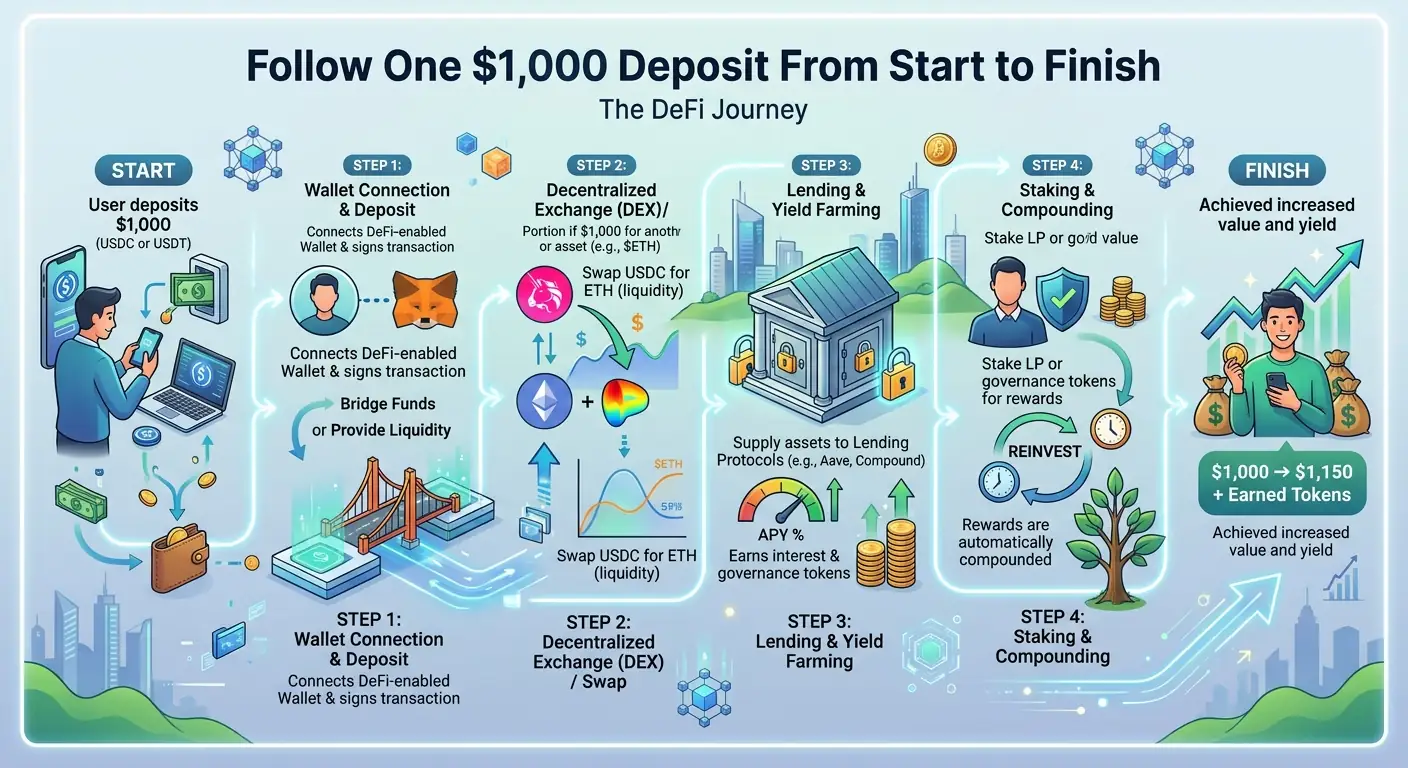
Imagine Alex has $1,000 in USDC sitting in a crypto wallet. He does not want to trade it or buy another cryptocurrency. Instead, he wants to understand whether he can put that money to work by lending it through a decentralised finance platform.
He opens a DeFi application, connects his wallet and finds an option to supply USDC. A few transactions later, his deposit is part of a shared liquidity pool that other users can borrow from.
This is one of the most common ways to use decentralised finance, or DeFi. But what actually happens to the money after Alex clicks Supply? Where does the interest come from? Can he withdraw whenever he wants? And what could go wrong?
To answer these questions, let’s follow his $1,000 deposit from beginning to end.
1. First, what is DeFi?
Decentralised finance refers to financial services built on blockchain networks and operated through smart contracts.
Traditional financial services usually rely on intermediaries. If someone deposits money in a bank, the bank manages the funds, records the balance and decides how to use its available capital. Customers interact with the bank through accounts, applications and customer service.
DeFi works differently. Instead of relying on a single financial institution to manage every operation, protocols use smart contracts: programmes deployed on a blockchain that execute predefined instructions when certain conditions are met.
These contracts can handle activities such as:
- Supplying digital assets to liquidity pools.
- Borrowing cryptocurrencies against collateral.
- Exchanging tokens.
- Calculating interest.
- Processing repayments and withdrawals.
Users interact with these protocols through applications, but the underlying operations take place on the blockchain.
This does not mean that every DeFi project is completely decentralised or free from intermediaries. Some rely on centralised infrastructure, external data providers, governance organisations or companies that maintain their interfaces.
For Alex, the important distinction is that he is not opening a traditional savings account. He is interacting with a blockchain-based financial protocol.
2. Alex chooses a lending protocol
Alex decides to use a lending protocol such as Aave.
Aave is a decentralised liquidity protocol that allows users to supply digital assets and earn interest. Other users can borrow those assets by providing collateral under the protocol’s rules.
The system connects two groups:
Suppliers: People who deposit assets into a liquidity pool. They make those assets available to borrowers and may receive interest in return.
Borrowers: People who obtain assets from the pool. They pay interest and generally need to provide collateral worth more than the amount they borrow.
For example, someone might deposit ETH as collateral and borrow USDC. They can use the borrowed stablecoins without selling their ETH, although their position remains exposed to price movements and liquidation risk.
Alex will be a supplier. He is not lending his money directly to one identifiable person. His USDC enters a shared pool managed by smart contracts.
That distinction matters because the protocol, rather than Alex, manages the rules for borrowing, repayment, collateral and interest.
3. He connects his crypto wallet
Before depositing anything, Alex needs a compatible crypto wallet containing USDC.
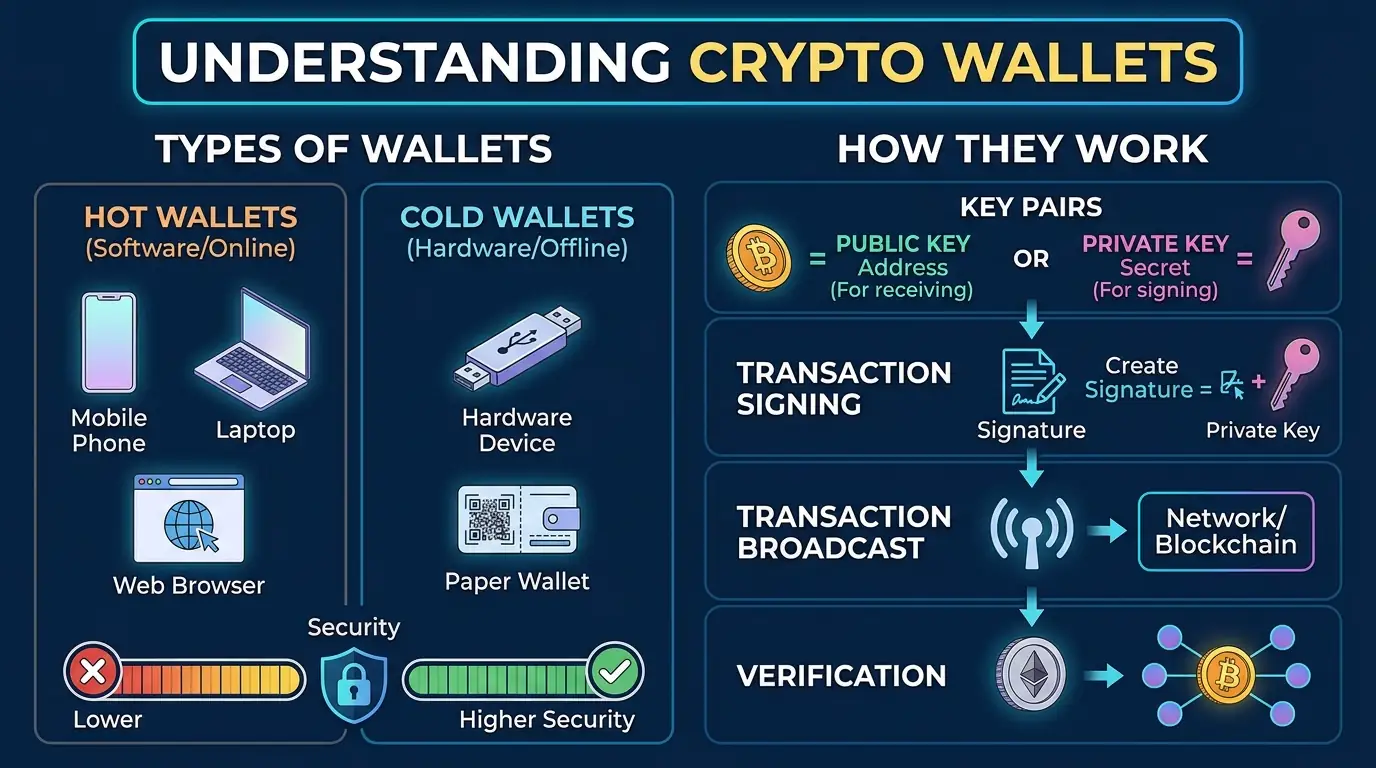
A wallet does not physically store the cryptocurrency. It manages the cryptographic keys that allow its owner to authorise transactions involving assets recorded on the blockchain.
Alex visits the protocol’s official application and connects his wallet.
At this point, connecting the wallet does not automatically transfer his funds. It simply allows the application to read relevant wallet information and prepare transactions for his approval.
He checks three things before continuing:
- The website is the official protocol interface.
- The selected blockchain network is the one he intends to use.
- The token is the correct USDC asset on that network.
This last point is particularly important. The same token name can appear on different blockchains, and a token with a familiar name is not necessarily the genuine asset he expects.
4. The first transaction: granting permission
Alex selects USDC and enters $1,000.
Depending on the token and protocol, he may first need to approve the smart contract to transfer his USDC.
This is known as a token allowance.
In simple terms, Alex is giving a specific smart contract permission to move a certain amount of tokens from his wallet. It is not the same as handing over his private keys, but it is still an important permission.
He should check:
- Which contract is requesting access.
- Which token the permission applies to.
- Whether the allowance is limited to the amount he intends to deposit.
- Whether the wallet is asking him to sign a message or confirm an on-chain transaction.
An approval may require a network fee. Some tokens and protocols support methods that combine authorisation and the deposit into fewer steps, but this depends on the technology being used.
Once Alex approves the transfer, he can proceed with the supply transaction.
5. His $1,000 enters the liquidity pool
Alex confirms the deposit.
The transaction is sent to the blockchain, where the relevant smart contracts execute the operation. Once it is successfully processed, his USDC is supplied to the protocol’s liquidity pool.
The pool is not a conventional bank account. It is a collection of assets managed by smart contracts according to predefined rules.
Other users can borrow available USDC, provided they meet the protocol’s requirements.
In return for supplying his assets, Alex receives aTokens. In an Aave market, for example, a USDC deposit can generate a corresponding interest-bearing token called aUSDC.
These tokens represent his position in the pool. Their balance increases over time as interest accrues, according to the applicable market rate.
Alex can see his position through the protocol’s interface, but the underlying information is recorded on the blockchain.
His original USDC is no longer sitting in his personal wallet as an available balance. It has been supplied to the protocol, and his aTokens represent his claim on the deposited asset and the interest accrued.
6. Where does the interest come from?
This is the part that often gets misunderstood.
DeFi protocols do not create interest simply because someone deposits money. In lending markets, much of the yield paid to suppliers comes from the interest borrowers pay.
Imagine that another user wants to borrow USDC from the pool. To do so, they must provide acceptable collateral and follow the protocol’s borrowing limits.
The borrower receives the USDC and pays interest while the loan remains outstanding.
Part of that interest is distributed to suppliers such as Alex. The protocol may also have other sources of revenue or fees, depending on its design.
The amount Alex earns is not necessarily fixed.
Supply rates can change as market conditions change. One important factor is utilisation: the proportion of the available assets that borrowers have taken from the pool.
If demand for borrowing increases, utilisation may rise and the protocol’s interest-rate model may increase borrowing costs. This can also raise the rate paid to suppliers.
If borrowing demand falls or more assets enter the pool, the supply rate may decrease.
That means the rate displayed when Alex deposits his USDC is not a promise that he will earn the same percentage throughout the year.
7. What could $1,000 become after one year?
To understand how the figures work, let’s use a hypothetical annual percentage yield (APY) of 4%.
APY represents the annual return after taking compounding into account. It is useful for estimating potential growth, but in a variable-rate DeFi market it does not guarantee what the user will actually earn.
If Alex’s $1,000 earned a constant 4% APY for a full year, the calculation would look like this:
| Item | Amount |
|---|---|
| Initial deposit | $1,000.00 |
| Illustrative APY | 4% |
| Estimated interest after one year | $40.00 |
| Estimated final balance | $1,040.00 |
This is a simplified illustration. It assumes that the rate remains unchanged, that interest compounds as represented by the APY, and that there are no fees, losses or changes in the value of USDC.
In a real DeFi market, the result could be higher or lower.
Alex might earn less if the supply rate falls. He might also have to pay network fees when depositing or withdrawing. Those costs reduce the amount he ultimately receives.
The key point is that a displayed APY is a snapshot of a potential return, not a guaranteed payment.
8. Can Alex withdraw his money whenever he wants?
After several months, Alex decides that he wants his USDC back.
He opens the protocol interface, selects his supplied position and requests a withdrawal.
The smart contract checks whether enough liquidity is available in the pool. If the assets have not all been borrowed, the withdrawal can normally be processed, subject to the protocol’s other conditions.
However, there is an important limitation.
Alex’s deposit is part of a shared pool. If most of the available USDC has been borrowed, there may not be enough unborrowed liquidity to process his withdrawal immediately.
He may need to wait until borrowers repay their loans or other suppliers add liquidity.
This is known as liquidity risk.
A DeFi deposit should therefore not be treated as a bank account with guaranteed immediate access to funds. The ability to withdraw depends on the protocol’s rules and the liquidity available at that moment.
9. What happens if something goes wrong?
Alex has followed the steps correctly, but that does not eliminate the risks.
DeFi removes or reduces some traditional intermediaries, but it introduces technical and financial risks of its own.
Smart contract vulnerabilities
A smart contract is software. It can contain errors or security weaknesses.
If an attacker exploits a vulnerability in a protocol’s contracts, funds may be stolen, frozen or made inaccessible.
Audits, formal verification and bug bounty programmes can help identify problems, but none guarantees that a protocol is completely secure.
Stablecoin risk
Alex deposited USDC because he wanted to avoid the price volatility associated with assets such as Bitcoin or Ethereum.
USDC is designed to maintain a value close to one US dollar and is backed by reserves, according to its issuer, Circle. However, this does not make it risk-free.
Its market price could temporarily move away from its intended value. Users also depend on the issuer’s ability to maintain the reserve and redemption arrangements, as well as the banking and regulatory systems involved.
Liquidity risk
Even if the protocol is operating correctly, Alex may not be able to withdraw immediately if too much of the available USDC has been borrowed.
This risk becomes particularly relevant during periods of market stress, when many users may want to withdraw at the same time.
Oracle risk
Some DeFi protocols rely on oracles to obtain information from outside the blockchain, such as cryptocurrency prices.
If an oracle provides incorrect or manipulated data, a protocol may calculate collateral values incorrectly. That can affect borrowing limits, liquidations and the overall stability of the system.
Network and governance risk
A protocol may depend on the blockchain it operates on, other connected networks, bridges or decisions made through its governance process.
Network congestion can make transactions slower or more expensive. Changes to protocol parameters can also affect the conditions under which users supply or borrow assets.
These risks are different, but they can overlap. A problem with one component may affect the rest of the system.
10. Alex withdraws his USDC
Assuming the protocol remains operational and sufficient liquidity is available, Alex can now complete his withdrawal.
He submits the transaction, pays the applicable network fee and receives his USDC back in his wallet, together with any interest accrued.
For this example, imagine that his position has generated $15 in interest and that the combined costs of depositing and withdrawing amount to $6.
His final result would be:
| Item | Amount |
|---|---|
| Initial deposit | $1,000.00 |
| Interest earned | +$15.00 |
| Transaction costs | -$6.00 |
| Final amount received | $1,009.00 |
Alex has earned $9 after costs.
This example shows why the advertised interest rate is only one part of the calculation. Network fees, changing rates and the conditions of the protocol all affect the final result.
11. What does this example tell us about DeFi?
Following Alex’s deposit makes the basic lending process easier to understand.
He connected a wallet, approved a token transfer, supplied USDC to a liquidity pool, received an interest-bearing token and eventually withdrew his funds.
The process did not require a traditional bank to manage the loan. Smart contracts handled the transactions according to the protocol’s rules.
But the absence of a traditional intermediary does not mean the absence of risk.
Users still need to understand where their assets are deposited, how the protocol generates returns, what permissions they grant and what conditions could prevent a withdrawal.
DeFi is not one single product. It is an ecosystem of lending markets, decentralised exchanges, liquidity pools, derivatives and other financial applications. Each has its own mechanics and risks.
For someone exploring this ecosystem, understanding the journey of a single deposit is a useful starting point. Before focusing on the potential return, it is worth understanding what happens to the assets after they leave the wallet.
Sources
- Aave – Supply Tokens
Explains how users supply assets, approve token transfers, receive interest and interact with liquidity pools. - Aave – Liquidity Pool
Describes how suppliers and borrowers interact and how interest rates are determined. - Aave – Protocol Risks
Covers smart contract, oracle, collateral, liquidity, liquidation and network risks. - Aave – Frequently Asked Questions
Provides information about supplied assets, withdrawals, interest and protocol limitations. - Aave – Glossary
Defines technical terms such as APY, aTokens, collateral and borrowing. - Circle – USDC Transparency and Reserves
Explains how USDC is backed and how Circle reports information about its reserves. - Ethereum.org – Smart Contract Security
Explains smart contract vulnerabilities, oracle manipulation and security considerations.