Cryptocurrencies are digital assets that can be transferred between users over a computer network. Unlike traditional money held in a bank account, many cryptocurrencies operate without a central institution processing every transaction. Instead, they rely on a combination of cryptography, distributed networks and software rules to record and verify transfers.
Bitcoin is the best-known example, but it is only one of thousands of cryptocurrencies. Others, such as Ethereum, have different purposes and support additional functions, including applications that run directly on the network.
To understand what cryptocurrency is, it helps to start with a simple question: what happens when someone sends digital money to another person?
How does a cryptocurrency transfer work?
Imagine that Alice wants to send a small amount of Bitcoin to Bob.
In a conventional bank transfer, Alice instructs her bank to move money from her account to Bob’s. The bank checks whether the transaction can be processed, updates its records and communicates the result to the other financial institution if necessary.
A Bitcoin transfer follows a different process.
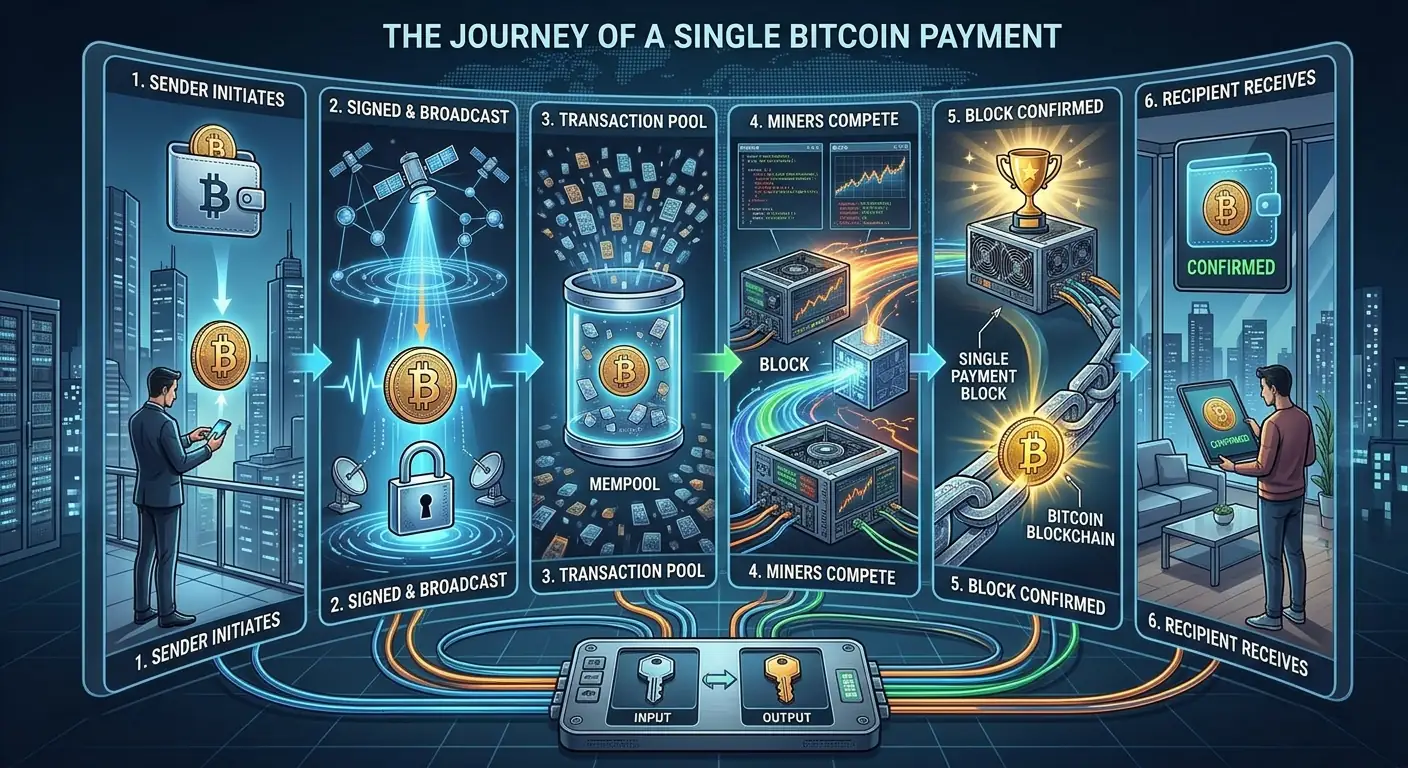
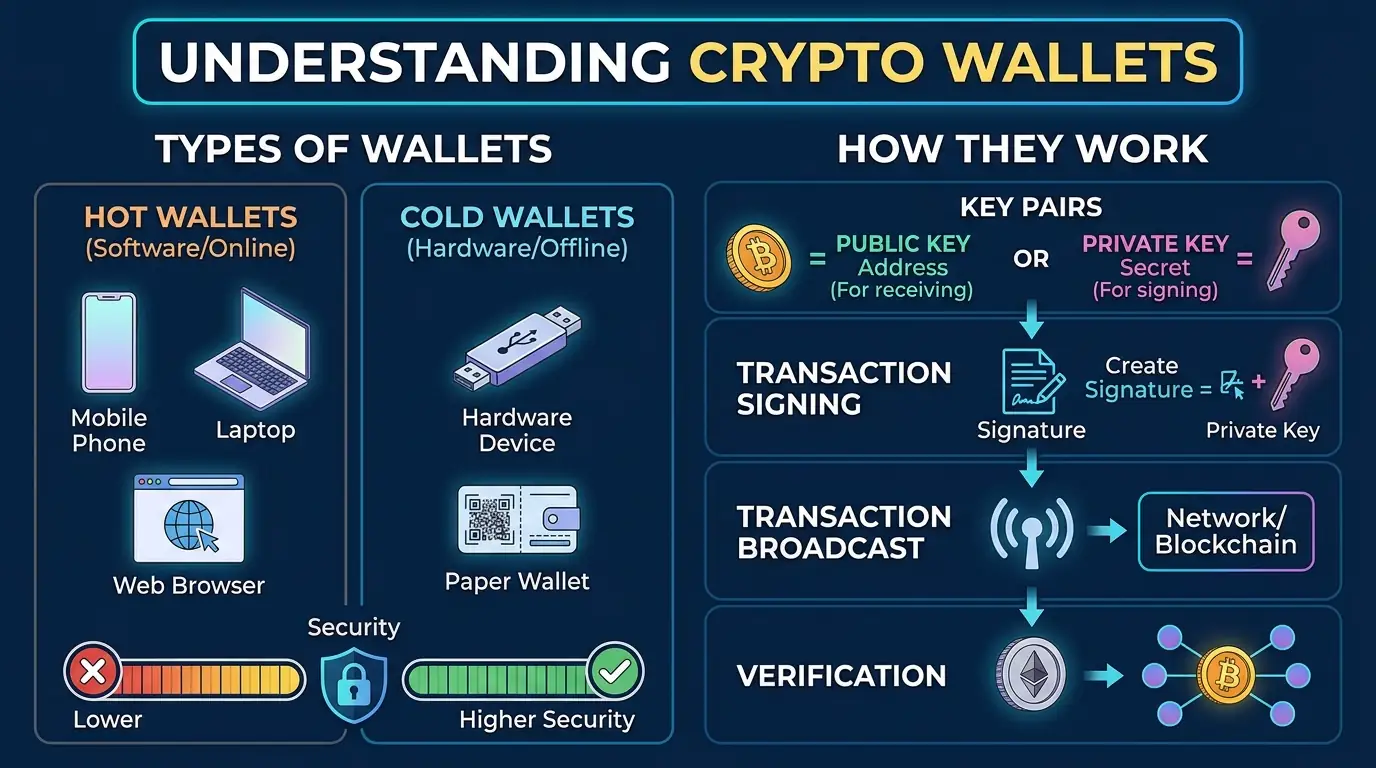
Alice uses a cryptocurrency wallet to create a transaction. The wallet prepares the information needed to send the Bitcoin to Bob’s address. Alice then authorises the transaction using her private key, which acts as cryptographic proof that she is allowed to spend the funds.
The transaction is broadcast to the Bitcoin network. Computers participating in the network receive it and check whether it follows the protocol’s rules. These checks include verifying the digital signature and confirming that the Bitcoin being spent has not already been used in another transaction.
If the transaction is valid, it can be included in a block. Bitcoin miners compete to add new blocks to the blockchain through a process called proof of work. Once the block is accepted by the network, the transaction becomes part of Bitcoin’s public transaction history.
Bob can then see the incoming payment in his wallet. Depending on the wallet and the number of confirmations, the transaction may initially appear as pending before being treated as sufficiently confirmed.
This process does not require Alice and Bob to have accounts at the same bank. They only need compatible wallets and access to the network.
What makes cryptocurrency different from traditional money?
The main difference is not simply that cryptocurrency is digital. Most modern money is already digital: salaries are paid into bank accounts, card payments are processed electronically and people regularly transfer funds using banking apps.
The important distinction is how the system is organised and who maintains its records.
In traditional banking, financial institutions keep centralised records of account balances and transactions. Customers generally rely on these institutions to process payments, correct errors and provide access to their funds.
In a decentralised cryptocurrency network, transaction records are maintained by a distributed system of computers. The network follows a shared protocol that determines which transactions are valid and how new records are added.
This changes the relationship between users and financial intermediaries. Someone holding cryptocurrency in a self-custody wallet can control the keys needed to authorise transactions without asking a bank to approve each transfer.
However, this does not mean that every cryptocurrency is decentralised. Some projects rely heavily on a small group of organisations, validators or administrators. The degree of decentralisation varies from one network to another.
What is a blockchain?
A blockchain is a type of digital ledger that stores information in groups called blocks. These blocks are linked together in chronological order using cryptographic techniques.
Each block contains transaction data and information that connects it to the previous block. This structure makes it difficult to alter historical records without the network detecting the change.
In Bitcoin, the blockchain records transactions involving Bitcoin. It allows participating computers to check the history of the funds being transferred and determine whether a transaction follows the network’s rules.
The blockchain is not the same thing as cryptocurrency itself. It is the technology used by certain cryptocurrency networks to organise and maintain their records.
Not every digital asset uses a blockchain in exactly the same way, and not every blockchain has the same design. Different networks make different choices about transaction speed, security, decentralisation and the amount of information they store.
Why is cryptography important?
Cryptography is essential because cryptocurrency networks need a way to establish ownership and authorise transactions without relying entirely on a central authority.
One of the most important mechanisms is public-key cryptography. It uses two mathematically related keys:
- Public key: Used to generate information that other people can use to verify a digital signature. It is not a secret in the same way as a private key.
- Private key: A secret value used to create digital signatures and authorise certain actions, such as spending cryptocurrency.
Wallets use these mechanisms to let users control their funds. In practice, many wallets generate addresses from public keys or related cryptographic data, so the address shown to another person is not necessarily the public key itself.
The private key must remain confidential. If someone obtains it, they may be able to move the associated cryptocurrency. Unlike a password for a conventional online account, a private key may not be recoverable through a customer support department.
Cryptography also helps protect the integrity of blockchain records. Hash functions, for example, produce fixed-length outputs from data and make it possible to detect changes in that data.
Are all cryptocurrencies the same?
No. The word cryptocurrency covers a wide range of digital assets, and their purposes can be very different.
Bitcoin was designed as a peer-to-peer electronic payment system. Its network allows users to transfer value without relying on a traditional payment processor.
Ethereum is a blockchain platform that supports smart contracts. These are programmes that execute when predefined conditions are met. They allow developers to build applications for activities such as lending, trading and digital asset management.
Stablecoins are designed to maintain a relatively stable value against another asset, commonly the US dollar. Some are backed by reserves, while others use different mechanisms. Their stability depends on how the system is designed and whether it works as intended.
Utility tokens may provide access to specific services or functions within a project. Their purpose and value depend on the rules and demand associated with that ecosystem.
These examples illustrate why it is misleading to treat every cryptocurrency as if it were simply another version of Bitcoin. A network’s technology, governance, supply model and intended use all matter.
Can cryptocurrency be used as money?
Cryptocurrencies can be used to transfer value, and some businesses accept them as payment. However, their practical use as everyday money varies considerably.
There are three traditional functions associated with money:
- Medium of exchange: An asset used to pay for goods and services.
- Store of value: Something people hold in the expectation that it will preserve purchasing power over time.
- Unit of account: A common measure used to set prices and compare the value of goods and services.
Some cryptocurrencies can perform these functions in certain contexts, but they also face limitations.
Price volatility can make it difficult to use an asset as a stable unit of account. Transaction fees and confirmation times may affect its suitability for small purchases. Acceptance is also limited compared with national currencies.
Stablecoins attempt to reduce price fluctuations, but they introduce other considerations, including the quality of reserves, redemption arrangements, issuer reliability and regulatory requirements.
The fact that a cryptocurrency can be transferred does not automatically make it suitable for every payment.
What are the main risks of using cryptocurrency?
Cryptocurrency gives users new ways to hold and transfer digital assets, but it also creates responsibilities and risks.
Price volatility: The market value of many cryptocurrencies can change sharply. Someone who buys an asset for a particular amount may later find that it is worth considerably less.
Loss of access: Users who manage their own private keys must protect them. Losing the recovery phrase or private key can mean losing access to the funds permanently.
Irreversible transactions: Many blockchain transactions cannot simply be cancelled once confirmed. Sending funds to the wrong address or using an incompatible network can result in permanent loss.
Scams and impersonation: Fraudsters may create fake investment platforms, copy legitimate projects or contact users pretending to offer technical support.
Technical and operational failures: Exchanges, wallets, bridges and other services can suffer outages, security breaches or software problems. Using cryptocurrency through a third-party platform also introduces risks that are different from holding assets directly.
Understanding these risks is part of understanding the technology. Cryptocurrency is not automatically safer or more convenient than traditional financial services.
The key idea: cryptocurrency is a system, not just a digital coin
A cryptocurrency is more than a number displayed in a wallet. It exists within a network governed by software rules, cryptographic mechanisms and participants who help validate and record transactions.
When someone sends cryptocurrency, the network checks whether the transfer is authorised and valid. Its shared records allow participants to agree on the state of the system without necessarily relying on a single institution.
That is the central idea behind cryptocurrencies. To understand any particular asset, it is worth looking beyond its price and asking how its network works, who maintains it, what it is designed to do and what risks users take when they interact with it.
Sources
- Bitcoin: A Peer-to-Peer Electronic Cash System — Original Bitcoin whitepaper.
- Bitcoin Developer Documentation — Technical documentation on Bitcoin transactions and network operation.
- Ethereum: What Is Ethereum? — Overview of Ethereum and its applications.
- NIST: Cryptographic Standards and Guidelines — Reference material on cryptographic principles.