Bitcoin is often described as digital money that operates without banks. That definition is useful, but it does not explain what actually happens when someone sends Bitcoin to another person.
Behind every payment, there is a process involving digital signatures, transaction verification, miners and a public record called the blockchain. These elements work together to allow people to transfer Bitcoin without asking a central institution to approve every transaction.
Understanding this process makes it easier to understand what Bitcoin is, how it works and why certain mistakes can be difficult to reverse.
What happens when you send Bitcoin?
Imagine that Alex wants to send 0.01 BTC to Sam. They live in different countries and do not share a bank account or use the same financial institution.
Alex opens a Bitcoin wallet, enters Sam’s Bitcoin address and specifies the amount to send. The wallet then prepares a transaction containing the information needed to transfer the funds.
At this point, no Bitcoin has physically moved between devices. Bitcoin is not a file that Alex sends to Sam. Instead, the transaction proposes a change in the ownership of value recorded by the Bitcoin network.
For the transaction to be accepted, it must satisfy the network’s rules.
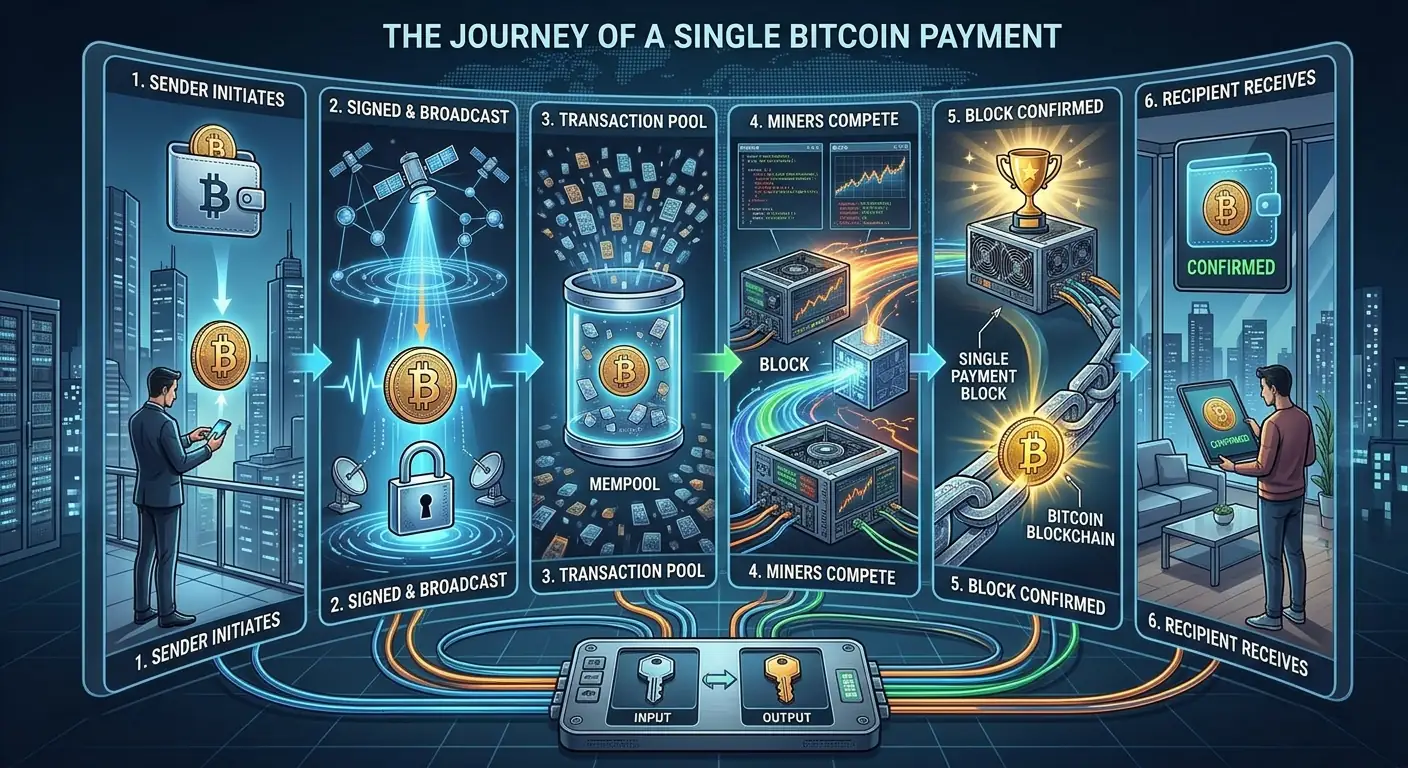
The process can be divided into several stages:
- Alex creates the transaction.
- The wallet signs it using the necessary private key.
- The transaction is broadcast to the Bitcoin network.
- Network participants check its validity.
- A miner includes it in a block.
- The block is accepted and added to the blockchain.
- Sam’s wallet recognises the incoming Bitcoin.
Each stage serves a different purpose.
Step 1: The wallet prepares the transaction
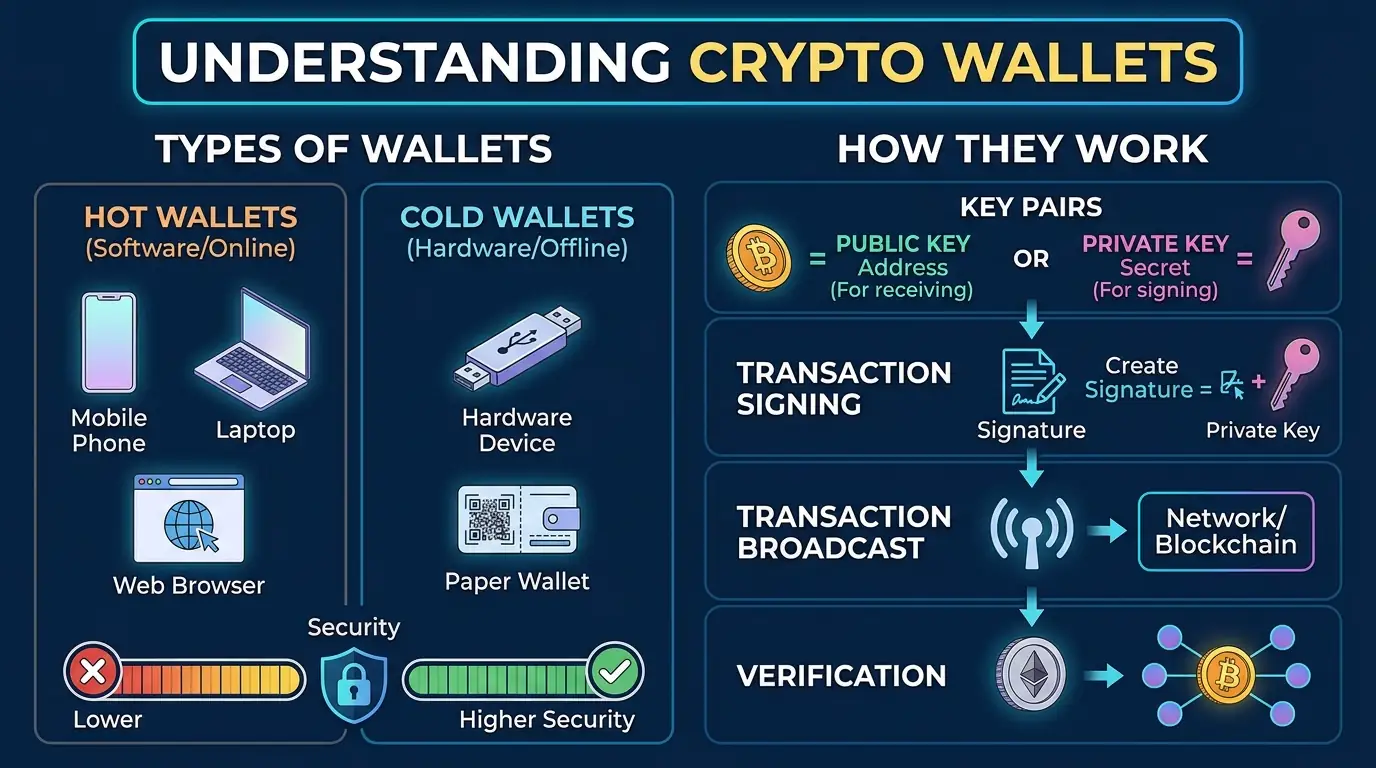
A Bitcoin wallet is the software or device Alex uses to manage access to Bitcoin.
When Alex enters Sam’s address and the amount, the wallet identifies the funds available to spend and prepares a transaction. It also calculates the network fee Alex is willing to pay.
Bitcoin uses a transaction model called Unspent Transaction Outputs, or UTXOs. Rather than maintaining a simple account balance in the same way a bank does, the network tracks outputs from previous transactions that have not yet been spent.
Think of them as individual digital payment amounts that can be used as inputs for a new transaction.
For example, imagine Alex previously received:
- 0.006 BTC from one payment.
- 0.008 BTC from another payment.
If Alex wants to send 0.01 BTC, the wallet may use both amounts as inputs. It creates an output of 0.01 BTC for Sam and another output returning the remaining value to Alex as change, after accounting for the transaction fee.
The wallet handles this calculation automatically in most cases.
This is why the balance displayed in a Bitcoin wallet does not necessarily correspond to one single unit or transaction. It is the combined value of available outputs.
Step 2: The transaction is signed
Before the transaction can be broadcast, Alex must authorise it.
This is where private keys become essential.
A private key is a secret cryptographic value that allows its holder to create digital signatures. The wallet uses the relevant private key to sign the transaction, providing mathematical proof that Alex is authorised to spend the funds.
Other participants can verify this signature using the corresponding public information without learning the private key itself.
This distinction is fundamental:
- The private key must remain secret.
- The public information allows others to verify signatures.
- The Bitcoin address is the destination identifier Alex uses to send funds.
A Bitcoin address is generally derived from cryptographic information associated with a public key or other spending conditions. It is not the private key and should never be confused with it.
The signature does not reveal Alex’s private key. It simply demonstrates that the transaction has been authorised by someone who controls the required cryptographic credentials.
If Alex loses access to the private key or recovery phrase, the funds may become inaccessible. Bitcoin does not have a central password-reset department.
Step 3: The transaction enters the Bitcoin network
Once signed, the transaction is broadcast to the Bitcoin network.
Bitcoin operates through a distributed network of computers called nodes. These nodes communicate with one another and maintain copies of the blockchain, subject to the rules they independently verify.
When a node receives Alex’s transaction, it checks several conditions.
Among other things, it verifies that:
- The transaction follows Bitcoin’s consensus and validation rules.
- The digital signatures are valid.
- The inputs refer to existing unspent outputs.
- The same funds have not already been spent.
- The transaction does not create more Bitcoin than the inputs allow.
If the transaction passes these checks, the node may relay it to other nodes.
Many nodes also keep valid, unconfirmed transactions in an area of memory called the mempool. The mempool is not one central database shared by every computer. Each node maintains its own view, so the transactions visible in one node’s mempool may differ from those visible in another.
At this stage, Alex’s payment has been broadcast, but it has not yet been confirmed in a block.
Step 4: Miners select transactions
Bitcoin uses a consensus mechanism called Proof of Work.
Miners collect valid transactions and organise them into candidate blocks. They then compete to find a valid block hash by performing large numbers of calculations.
This process requires computing power and electricity. It is designed to make adding new blocks costly while allowing other participants to verify the result relatively easily.
Miners generally have an economic incentive to prioritise transactions with higher fees relative to their size. This means that a transaction offering a higher fee rate may be selected before another transaction that has been waiting longer.
However, there is no universal guarantee that a particular transaction will be included within a specific period.
When a miner finds a valid block, it broadcasts that block to the network. Other nodes independently check that the block and its transactions follow Bitcoin’s rules.
If the block is valid, nodes can add it to their copy of the blockchain.
Step 5: The transaction is recorded in the blockchain
The blockchain is Bitcoin’s public transaction ledger.
It consists of blocks linked together in chronological order. Each block contains a reference to the previous block, creating a chain of records.
When Alex’s transaction is included in a valid block, it receives its first confirmation.
A confirmation means that the transaction has been recorded in a block accepted by the network. Every subsequent block added on top of that block increases its confirmation count.
For example:
- 1 confirmation: the transaction is included in a block.
- 2 confirmations: another block has been added after it.
- 3 confirmations: two additional blocks have been added after the original one.
More confirmations generally make it increasingly difficult to reverse the transaction through a chain reorganisation.
There is no single confirmation threshold that guarantees absolute safety in every situation. The appropriate number depends on the value being transferred, the recipient’s risk tolerance and the circumstances of the payment.
Small payments may be accepted with fewer confirmations, while exchanges and businesses handling larger amounts may require more.
Step 6: Sam receives the Bitcoin
Once the transaction is included in a block, Sam’s wallet can recognise the incoming payment.
The wallet checks the blockchain and identifies the output assigned to Sam’s address or spending conditions.
Sam can then see the incoming amount, although the wallet may display different statuses depending on the number of confirmations.
It is important to understand that the wallet does not physically store Bitcoin. It stores or manages the cryptographic information needed to access and authorise transactions involving the funds recorded on the blockchain.
This is similar to having a key that grants access to something recorded in a shared system rather than keeping the actual asset inside the device.
Why does a Bitcoin transaction need a fee?
Bitcoin transaction fees are payments made by users to incentivise miners to include their transactions in blocks.
The fee is not normally calculated as a fixed percentage of the amount being transferred. Instead, it is mainly related to the transaction’s size in virtual bytes and the fee rate offered.
This means that sending 0.001 BTC does not necessarily cost less than sending 1 BTC. A transaction’s structure and size can matter more than its monetary value.
Fees also change according to network demand.
When many people are trying to make transactions, competition for limited block space can increase fee rates. During quieter periods, users may be able to pay less and still have their transactions included relatively quickly.
Most wallets estimate fees automatically, but users should understand the difference between the amount being sent and the fee paid to the network.
Can a Bitcoin transaction be cancelled?
In most ordinary circumstances, a confirmed Bitcoin transaction cannot be cancelled or reversed.
This is an important difference between Bitcoin and many traditional payment systems.
For example, if someone makes a bank transfer to the wrong account, the bank may be able to investigate the issue and attempt to recover the money, depending on the circumstances and applicable rules.
Bitcoin does not have a central authority with the power to reverse a valid transaction simply because the sender made a mistake.
There are some technical mechanisms that can affect unconfirmed transactions, including Replace-by-Fee in transactions that signal support for it. These mechanisms do not provide a general refund system and should not be confused with cancelling a confirmed payment.
If Alex sends Bitcoin to the wrong address and the transaction is confirmed, recovering the funds will usually depend on whether the person controlling that address is willing and able to return them.
This is why checking the destination address before confirming a payment is essential.
Is Bitcoin anonymous?
Bitcoin is often described as anonymous, but that is not entirely accurate.
The Bitcoin blockchain is public. Anyone can inspect transactions, amounts, addresses and the movement of funds between them.
However, Bitcoin addresses do not automatically display the real names of their owners. This makes Bitcoin pseudonymous rather than fully anonymous.
For example, someone may see that a particular address received 0.5 BTC and later transferred part of that amount to another address. They cannot necessarily identify the person behind either address from the blockchain alone.
The situation changes if an address becomes linked to a real identity. This may happen when someone uses a cryptocurrency exchange that requires identity verification, publishes an address online or shares transaction details that reveal their activity.
Blockchain analysis can also identify patterns and connections between addresses, although these conclusions are not always definitive.
Users should therefore avoid assuming that Bitcoin transactions are private simply because their names do not appear on the blockchain.
What makes Bitcoin transactions secure?
Bitcoin’s security does not depend on one single feature. It comes from several mechanisms working together.
Digital signatures prove that a transaction has been authorised by someone controlling the necessary private key.
Transaction validation allows nodes to reject payments that violate the network’s rules.
Proof of Work makes it expensive to rewrite the blockchain’s history because an attacker would need to reproduce substantial computational work.
Distributed verification means that independent nodes can check transactions and blocks rather than trusting a single central database.
These mechanisms provide a strong security model, but they do not eliminate every risk.
A user can still lose funds by exposing a private key, falling for a phishing attack, using a compromised device or sending Bitcoin to an incorrect address.
The network may work exactly as designed while the user makes a costly mistake.
The journey of a Bitcoin payment, in perspective
Sending Bitcoin involves much more than entering an address and pressing a button. The wallet prepares the transaction, the private key authorises it, nodes verify it, miners include it in a block and the blockchain records the result.
For the sender and recipient, most of this process happens in the background. A wallet presents a simple interface, but behind it operates a network of independent participants following the same protocol.
Understanding these steps helps users make better decisions about transaction fees, confirmation times, wallet security and the importance of checking payment details before sending funds.
Sources
- Bitcoin: A Peer-to-Peer Electronic Cash System — Original Bitcoin whitepaper, explaining the peer-to-peer payment system and Proof of Work.
- Bitcoin Developer Guide — Technical documentation covering transactions, wallets, nodes and mining.
- Bitcoin Developer Reference — Reference for Bitcoin transactions, blocks and network data.
- Bitcoin Optech — Technical resources explaining Bitcoin protocol features, transaction fees and network developments.