Imagine buying a digital artwork for $2,000. The transaction is recorded on a blockchain, your wallet receives a unique token, and the marketplace displays your name as its owner.
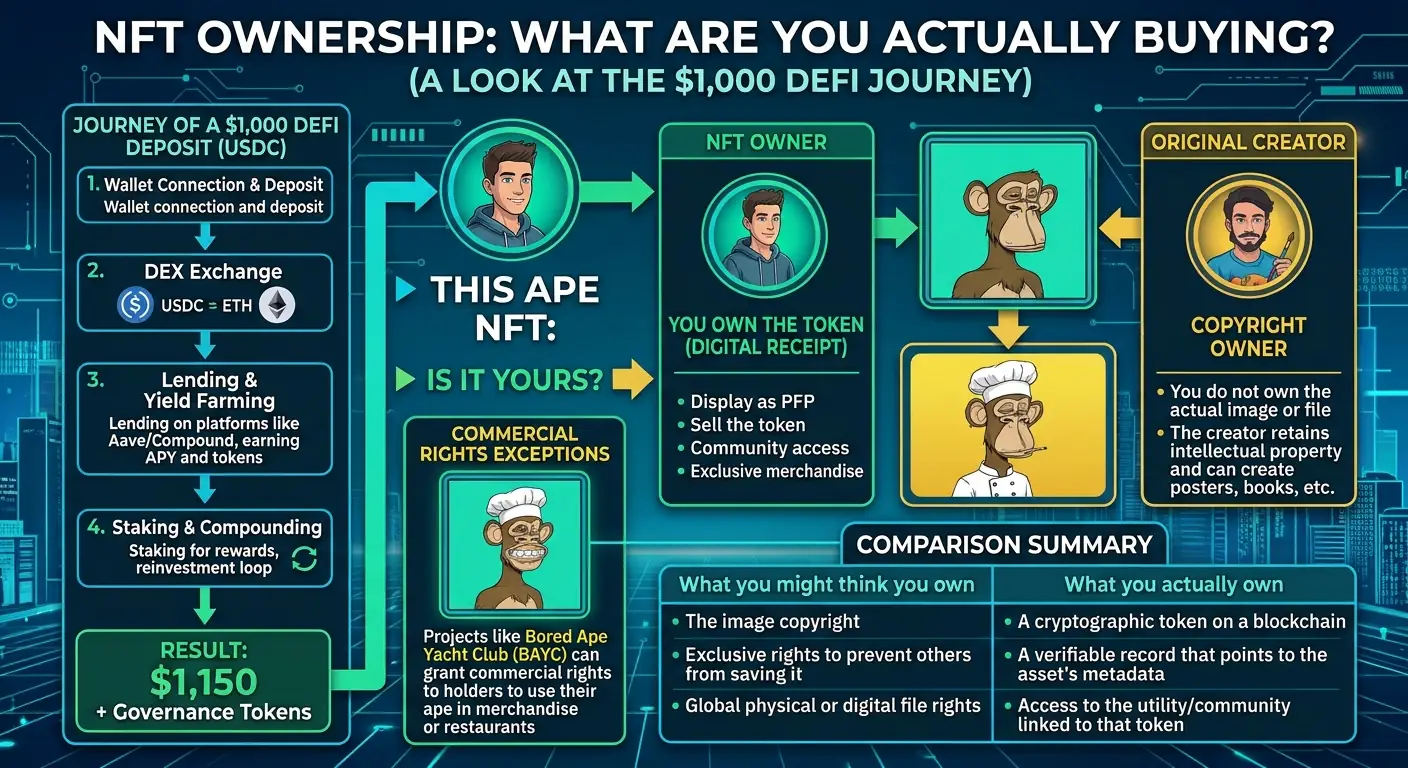
You now own the NFT. But can you print the image, use it on a T-shirt, sell copies of it or stop other people from sharing it online?
Not necessarily.
This is one of the biggest misunderstandings surrounding non-fungible tokens (NFTs). Buying an NFT does not automatically mean buying the image itself, and it does not necessarily give you the copyright to the artwork.
To understand what an NFT actually gives you, it helps to separate three things: the token, the digital file and the intellectual property rights associated with the work.
1. What are you actually buying when you purchase an NFT?
An NFT is a unique digital token recorded on a blockchain. Unlike cryptocurrencies such as Bitcoin or Ether, which are interchangeable with other units of the same asset, each NFT has its own identifier.
The token can represent or reference a digital artwork, a collectible, a membership pass, a ticket or another type of digital item.
When someone buys an NFT, the blockchain records a transfer of that token from one address to another. The new owner can verify the transaction and check the token’s history using a blockchain explorer.
However, the blockchain record does not automatically establish ownership of every right associated with the content.
For example, buying an NFT linked to a photograph does not necessarily give the buyer the right to reproduce that photograph commercially. The transaction transfers the token, but the copyright may remain with the photographer.
The distinction is similar to buying a numbered print of a painting. You may own that particular copy, but you do not automatically own the artist’s copyright or the right to produce and sell additional copies.
The same principle applies to NFTs: ownership of the token and ownership of the underlying intellectual property are separate matters.
2. The token, the image and the copyright are different things
To see why this distinction matters, consider the three elements involved in a typical NFT purchase.
The NFT itself
This is the unique token recorded on the blockchain. Its ownership can be transferred, and its transaction history can be checked publicly.
The digital artwork
This is the image, video, music file or other content associated with the token. In many projects, the file is not stored directly on the blockchain. Instead, the NFT contains a reference to metadata that identifies or links to the content.
The copyright
Copyright determines who has the legal rights to control certain uses of the original work. Depending on the applicable law, these rights can include reproduction, distribution, adaptation and public communication.
These three elements can belong to different parties.
An artist might create an image, retain all copyright rights and sell an NFT connected to that image. The buyer receives the token, but the artist continues to control the use of the artwork unless the purchase terms provide otherwise.
This is why checking what an NFT represents is not enough. Buyers also need to understand what rights, if any, are included in the sale.
3. How does an NFT connect to an image?
A common misconception is that the image is stored inside the NFT.
In many cases, it is not.
On networks such as Ethereum, NFT standards such as ERC-721 allow a token to be associated with metadata through a token URI. This reference can point to information describing the NFT, including its name, attributes and image location.
The structure often looks something like this:
- A smart contract identifies the NFT through its token ID.
- The contract provides a reference to its metadata.
- The metadata contains details about the digital item.
- The metadata may include a link to the image or another media file.
This means the blockchain can record who owns the token without storing the complete artwork on the network.
There are several ways to store the associated content.
Centralised servers
Some NFTs reference files hosted on a conventional web server. This is relatively straightforward, but the content depends on the server remaining available. If the owner stops maintaining it, the image or metadata may disappear.
IPFS
The InterPlanetary File System (IPFS) is a distributed system for addressing and sharing files. Content is identified through a unique identifier called a Content Identifier (CID).
Unlike a conventional web address, an IPFS identifier is based on the content itself. If the file changes, its identifier changes too.
However, this does not mean that every IPFS file will remain available forever. Someone still needs to keep the content accessible by maintaining or pinning it on the network.
On-chain storage
Some projects store the artwork or its metadata directly on the blockchain. This can make the content less dependent on external servers, although storing large files on-chain can be expensive.
The storage method matters because owning a token does not guarantee that its associated image will always be accessible.
4. If everyone can see the image, what makes the NFT unique?
Digital images can be copied perfectly. Someone can save an image, take a screenshot or share it on social media without owning the NFT.
So what does the buyer actually possess?
The answer is the specific token, identified by its smart contract and token ID.
Think of a limited-edition physical print. Several people may own copies of the same image, but each print can have its own number and provenance.
An NFT uses blockchain records to identify a particular token and show its transaction history. Anyone can view the associated artwork, but only the address recognised by the smart contract as the current owner controls that particular token.
This creates a distinction between copying the content and transferring the token.
A screenshot of an NFT does not give someone ownership of the original token. Equally, owning the token does not automatically give someone exclusive control over the image.
The blockchain can establish the token’s recorded ownership. It cannot, by itself, prevent other people from copying the associated file.
5. What rights do NFT buyers actually receive?
There is no universal licence that applies to every NFT.
The rights depend on the terms established by the creator, the seller, the marketplace and any applicable legal agreement.
A project might allow buyers to:
- Display the artwork for personal use.
- Use the image as a profile picture.
- Print the artwork for personal purposes.
- Use the image commercially, subject to specific limits.
- Create derivative works.
- Transfer the NFT together with certain associated rights.
Another project might grant only a limited right to display the artwork while prohibiting commercial reproduction.
Some collections offer commercial-use licences, but their conditions can differ significantly. They may impose revenue limits, restrict certain types of business activity or define how the artwork can be modified.
The important point is that these permissions do not arise automatically from the blockchain transaction.
Before buying, the buyer should look for the project’s licence, terms of sale or other documentation explaining what is permitted.
If the seller claims to transfer copyright itself, the buyer should check whether the agreement actually does so and whether it meets the legal requirements of the relevant jurisdiction.
6. Can an artist sell an NFT without owning the copyright?
No one can assume that a person selling an NFT has the legal right to sell the associated artwork.
An NFT can be created using an image without the original creator’s permission. The fact that a token has been minted and listed on a recognised marketplace does not prove that the person who created it owns the copyright.
For example, imagine someone downloads a digital illustration created by an independent artist and turns it into an NFT.
The blockchain may record that person’s wallet as the creator or initial seller of the token. But that record does not prove that they created the illustration or obtained permission to use it.
The original artist may still hold the copyright and may have grounds to challenge the unauthorised use.
This creates a practical problem for buyers. They can purchase a token that exists on the blockchain but is connected to content that the seller had no right to commercialise.
Before purchasing an NFT, it is worth checking:
- Whether the creator has an established identity.
- Whether the collection is linked to the creator’s official website or channels.
- Whether the project explains its intellectual property terms.
- Whether the artwork appears to have been copied from another artist.
- Whether the seller has authority to offer the associated rights.
A verified marketplace account or a visible blockchain transaction is not a substitute for checking the origin and legal status of the artwork.
7. What happens when you resell an NFT?
NFTs can generally be transferred or sold to another wallet, provided the smart contract and platform allow it.
When the transaction is completed, the blockchain records the new owner.
But what happens to the rights associated with the image?
That depends on the licence or agreement.
If the original creator granted a licence that applies to the current owner of the NFT, the new buyer may receive the same permissions when the token is transferred. However, this should not be assumed.
Some licences are personal and may not transfer automatically. Others are designed to follow the token and apply to whoever owns it.
The distinction also matters for royalties.
An NFT smart contract or marketplace may support payments to the creator when a token is resold. However, the payment rules depend on the contract and marketplace implementation. Not every marketplace enforces royalties in the same way, and technical mechanisms do not necessarily guarantee that every resale will generate a payment.
In other words, selling the NFT does not automatically settle every question about copyright, licensing or creator compensation.
8. What should you check before buying an NFT?
The artwork may be attractive, the collection may have an active community and the price may seem reasonable. But those factors do not tell you what you are actually purchasing.
Before spending money, examine the following points.
1. Identify the official collection
Check the creator’s official channels and confirm the collection’s contract address. Similar names and copied images can make unofficial collections look legitimate.
2. Read the licence
Look for the exact terms governing personal use, commercial use, reproduction and derivative works. If there is no clear licence, do not assume you have broad usage rights.
3. Check where the artwork is stored
Find out whether the image and metadata are hosted on a centralised server, IPFS, Arweave or directly on-chain. Each option has different implications for long-term availability.
4. Understand what the token represents
An NFT might represent a collectible, a membership, access to a service or a digital artwork. These uses are not interchangeable, and the token may depend on an external service to provide its promised benefits.
5. Verify the seller’s authority
A token can be technically valid while being linked to artwork that has been used without permission. Look for evidence that the creator or seller has the necessary rights.
6. Check whether the rights transfer on resale
If you plan to sell the NFT later, find out whether the associated licence follows the token or remains with the original buyer.
9. So, do you own the picture?
Not necessarily. You own the NFT recorded in your wallet, but the rights to the image depend on the terms of the transaction and the applicable copyright law.
An NFT can provide a verifiable record of ownership for a unique token. It can also link that token to a digital artwork, a membership or another asset.
But blockchain technology does not automatically transfer copyright, guarantee that an image will remain available or prove that the original seller had permission to use the content.
The distinction is simple: owning the token is not the same as owning every right associated with the content it represents.
That is why an NFT purchase should be treated as more than a transaction on a blockchain. Understanding the token, the underlying asset and the licence is essential to knowing what you are actually buying.