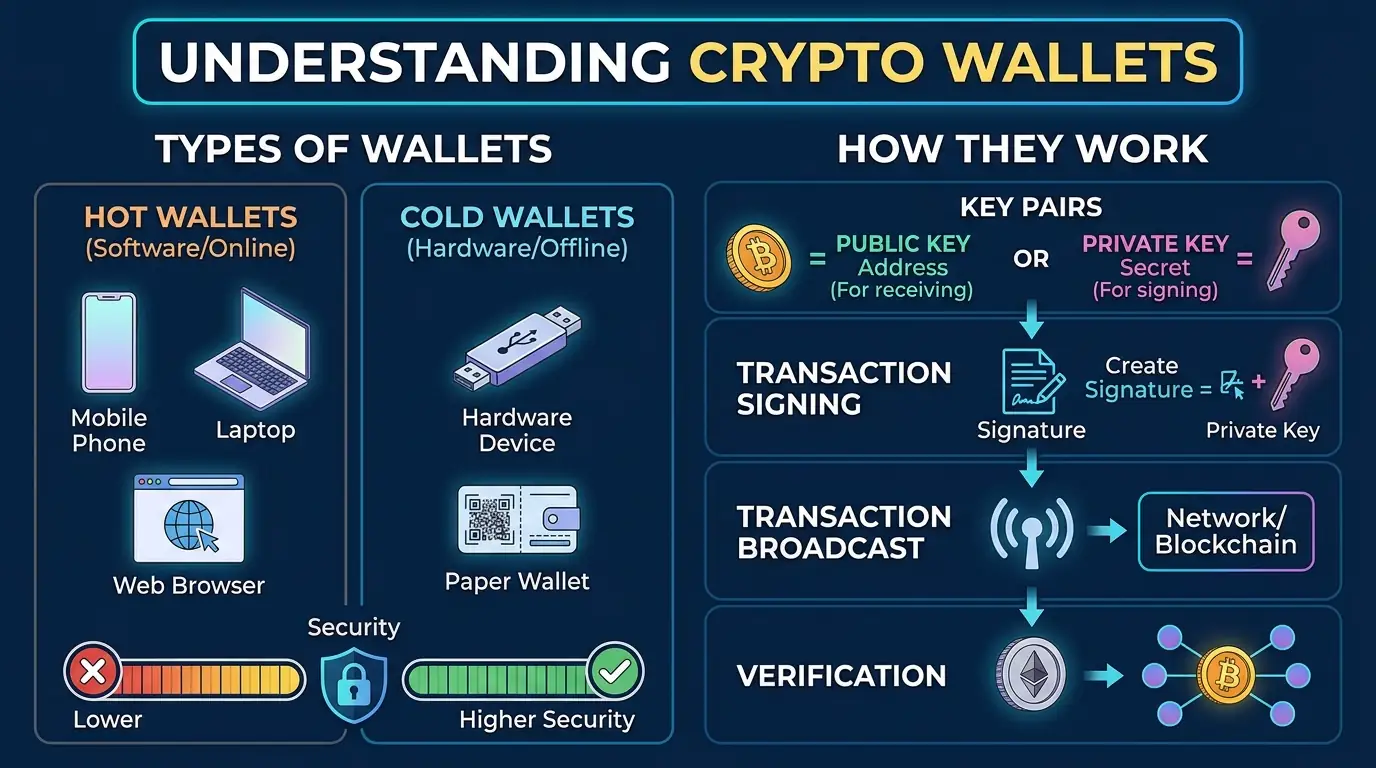
You can share your crypto wallet address with someone who wants to send you money. You can also publish it online, add it to a payment request or use it to receive funds from an exchange.
Your private key is different. It should never be shared.
This distinction is central to how cryptocurrency works. A wallet address allows other people to identify where they can send funds. A private key gives its holder the ability to authorise transactions from the corresponding account.
Understanding this relationship helps explain what crypto ownership actually means, why recovery phrases matter and what can happen if someone gets access to your keys.
What Is a Private Key?
A private key is a secret piece of cryptographic data used to create digital signatures.
In many cryptocurrencies, it is generated as a large random number. The wallet software uses it to produce a corresponding public key through a mathematical process. The public key can then be used to verify signatures created with the private key.
The relationship works in one direction:
Private key → Public key → Wallet address
The private key must remain secret. The public key and address can generally be shared.
For example, imagine that Alice wants to send cryptocurrency to Bob. Alice’s wallet uses her private key to sign the transaction. The network can then verify that the transaction was authorised by someone who controls the corresponding key.
Alice does not need to reveal the private key to the network. The signature provides the necessary proof.
This is the foundation of public-key cryptography.
Private Keys, Public Keys and Wallet Addresses Are Not the Same Thing
These three terms are often used as if they meant the same thing. They do not.
| Element | Purpose | Should it be secret? |
|---|---|---|
| Private key | Signs transactions and authorises actions | Yes |
| Public key | Allows signatures to be verified | No |
| Wallet address | Identifies where funds can be sent | No |
A wallet address is usually derived from a public key or from a hash of it. The exact process depends on the cryptocurrency and its address format.
In Bitcoin, for example, different address types use different scripts and derivation methods. Some addresses are based on a hash of a public key, while others represent more complex spending conditions.
Ethereum uses a different approach. An externally owned account has a public and private key pair, and its address is derived from the public key using Keccak-256.
The important point is that an address is not a password. Someone who knows your address can usually see its public transaction history on the blockchain, but that knowledge alone does not give them permission to move your funds.
How Does a Private Key Authorise a Transaction?
A private key does not work like a password that you type into every transaction. Wallet software uses it to generate a digital signature.
Consider a simple Bitcoin payment.
- Alice enters Bob’s address and the amount she wants to send.
- Her wallet prepares a transaction using the relevant Bitcoin inputs.
- The wallet uses Alice’s private key to create the required digital signature.
- The signed transaction is broadcast to the Bitcoin network.
- Network participants verify that the signature satisfies the spending conditions of the funds being used.
The private key itself is not broadcast. The network receives the transaction and its signature, then checks whether the signature is valid.
Ethereum follows the same broad principle, although its transaction structure and account model are different. An externally owned account uses its private key to sign transactions, including transfers and interactions with smart contracts.
This is why protecting the private key matters so much. Whoever controls it may be able to authorise transactions without asking the original owner for permission.
Why Can’t Someone Calculate Your Private Key From Your Public Key?
Public-key cryptography is designed to make one operation practical and the reverse operation computationally infeasible with known classical methods.
Generating a public key from a private key is straightforward for the cryptographic system. Reversing that process to discover the private key would require solving a mathematical problem that is considered computationally impractical at the security levels used by major cryptocurrencies.
This is not the same as saying that private keys are impossible to steal or recover. The mathematical relationship may be secure while the device or person handling the key is not.
For example, an attacker does not need to break the cryptography if they can:
- Install malware that steals wallet information.
- Trick someone into entering their recovery phrase on a fake website.
- Obtain an unencrypted backup.
- Access a compromised device.
- Persuade the owner to sign a transaction that transfers funds.
In practice, many attacks target the way people store and use keys rather than the underlying cryptographic algorithms.
What Is a Recovery Phrase?
Most modern wallets do not ask users to back up every private key individually. Instead, they often use a system known as a hierarchical deterministic wallet.
A wallet can generate a master seed and derive multiple private keys from it. This allows one recovery phrase to restore access to a collection of accounts and addresses, provided the wallet follows compatible standards and derivation settings.
The recovery phrase is commonly a sequence of 12, 18 or 24 words. A widely used standard for generating these phrases is BIP-39.
The words are not selected randomly by the user. They encode computer-generated entropy and a checksum, which are then converted into a binary seed used by compatible wallet systems.
This distinction matters:
- Private key: Controls a particular cryptographic account or spending authority.
- Recovery phrase: A human-readable backup used to regenerate a wallet’s underlying seed and, from it, the associated keys.
- Wallet password or PIN: Helps protect access to a particular application or device. It is not necessarily the same as the recovery phrase.
A recovery phrase can therefore be even more sensitive than an individual private key. If someone obtains it, they may be able to recreate multiple wallet accounts on another compatible device.
What About an Additional Passphrase?
Some wallets support an optional passphrase used alongside a BIP-39 recovery phrase.
This creates a different derived wallet from the same original words. Even a small difference in the passphrase produces a different result.
It can provide an additional layer of protection, but it also creates another recovery responsibility. If the passphrase is lost or entered incorrectly, the user may restore a valid wallet that does not contain the expected funds.
It should not be treated as a substitute for securely storing the original recovery phrase.
What Happens If You Lose Your Private Key?
The answer depends on how the wallet is designed and whether a valid backup exists.
If you lose access to a wallet application but still have its recovery phrase, you may be able to restore the wallet on another compatible device.
If you lose the device and the recovery phrase, and there is no other valid backup or recovery mechanism, you may permanently lose access to the funds.
There is no central authority that can simply reset a non-custodial private key in the way a bank can reset an online banking password.
This is one of the main differences between holding cryptocurrency through a custodial exchange and controlling a non-custodial wallet.
With a custodial service, the company manages the private keys and may offer account recovery procedures. With a non-custodial wallet, the user is responsible for protecting the keys and backups.
Neither arrangement removes every risk. A custodial account depends on the provider, while a non-custodial wallet depends heavily on the user’s own security practices.
What Happens If Someone Steals Your Private Key?
If an attacker obtains a private key, they may be able to sign transactions that move the associated funds.
Blockchain transactions are generally irreversible once confirmed. If the attacker transfers the cryptocurrency to another address, there is no ordinary chargeback process that automatically returns it.
The same principle applies to a compromised recovery phrase. An attacker may restore the wallet elsewhere and move the funds without having the original device.
There are a few important details to understand:
A wallet password may not be enough. Changing the password on the original application does not necessarily invalidate a private key or recovery phrase that has already been copied.
Moving the funds may be necessary. If a private key or recovery phrase is exposed, the safest response is generally to move the funds to a newly generated wallet with new keys, using a secure device and a clean recovery process.
Token approvals create another risk. On networks such as Ethereum, a user may have previously granted a smart contract permission to spend certain tokens. Depending on the approval, moving assets to a new address may not be sufficient if the old address still holds tokens or has active permissions. Those approvals need to be reviewed and revoked where appropriate.
If a recovery phrase has been exposed, do not assume that deleting the wallet application or changing its PIN solves the problem.
How to Protect Your Private Keys
Good key management is less about memorising complicated technical rules and more about avoiding a few serious mistakes.
Keep recovery phrases offline
Do not store recovery phrases in screenshots, email drafts, messaging applications or cloud notes. These services may be accessible from several devices and can become targets for attackers.
Use a secure physical backup method and protect it against theft, fire, water and accidental damage.
Never share your recovery phrase
A legitimate wallet provider should not need your recovery phrase to troubleshoot an account. Anyone asking you to send it, upload it or enter it into an unfamiliar website should be treated with suspicion.
Verify what you sign
A wallet signature is not always a simple payment. It can authorise a smart contract interaction, a token allowance or another operation with financial consequences.
Read the transaction details and check the destination and permissions before approving it. When using a hardware wallet, verify the information on the device’s own screen.
Test your recovery process
A backup that has never been checked may contain an incorrect word, an incomplete copy or a missing passphrase.
Make sure you understand how restoration works before relying on it. Do not experiment with your only backup or enter it into random online recovery tools.
Separate everyday activity from long-term holdings
A wallet used to connect to new applications has a different exposure profile from one used only to store funds.
Keeping these activities separate can limit the damage caused by a malicious website or an unsafe contract interaction.
Are Private Keys the Same Across All Cryptocurrencies?
No. The general principle is shared, but the technical details vary.
Bitcoin uses its own transaction and script system, with different address formats and signing methods. Ethereum externally owned accounts use elliptic-curve cryptography to derive public keys and addresses, while smart contract accounts are controlled by code rather than by a single private key.
Other networks may use different cryptographic curves, address formats, signature schemes or account models.
This is why a private key should only be imported into wallet software that explicitly supports the relevant network and key format. A key that works for one type of account should not be assumed to behave identically across every blockchain.
The Real Meaning of Crypto Ownership
Owning cryptocurrency does not mean holding coins inside a physical wallet. The blockchain records balances and transaction history. Private keys provide the cryptographic authority needed to authorise certain actions over those funds.
That authority is what makes key security so important.
Your address can be public. Your private key and recovery phrase cannot. If you understand that distinction, you have the basis for managing a crypto wallet without confusing receiving funds, proving control and protecting access.
Sources
- Ethereum.org – Ethereum Accounts
Explains Ethereum account types, public and private keys, address derivation and transaction signatures. - Bitcoin Improvement Proposal 39 – Mnemonic Code for Generating Deterministic Keys
Defines how mnemonic recovery phrases encode entropy and generate a wallet seed. - Bitcoin Improvement Proposal 32 – Hierarchical Deterministic Wallets
Describes how wallets derive multiple keys from a master seed. - Bitcoin Developer Guide – Transactions
Explains Bitcoin transaction structure, signatures and verification. - Bitcoin.org – Securing Your Wallet
Provides practical guidance on wallet backups, security and recovery. - Ethereum.org – Security and Scam Prevention
Covers wallet safety, phishing and common risks when interacting with crypto applications.