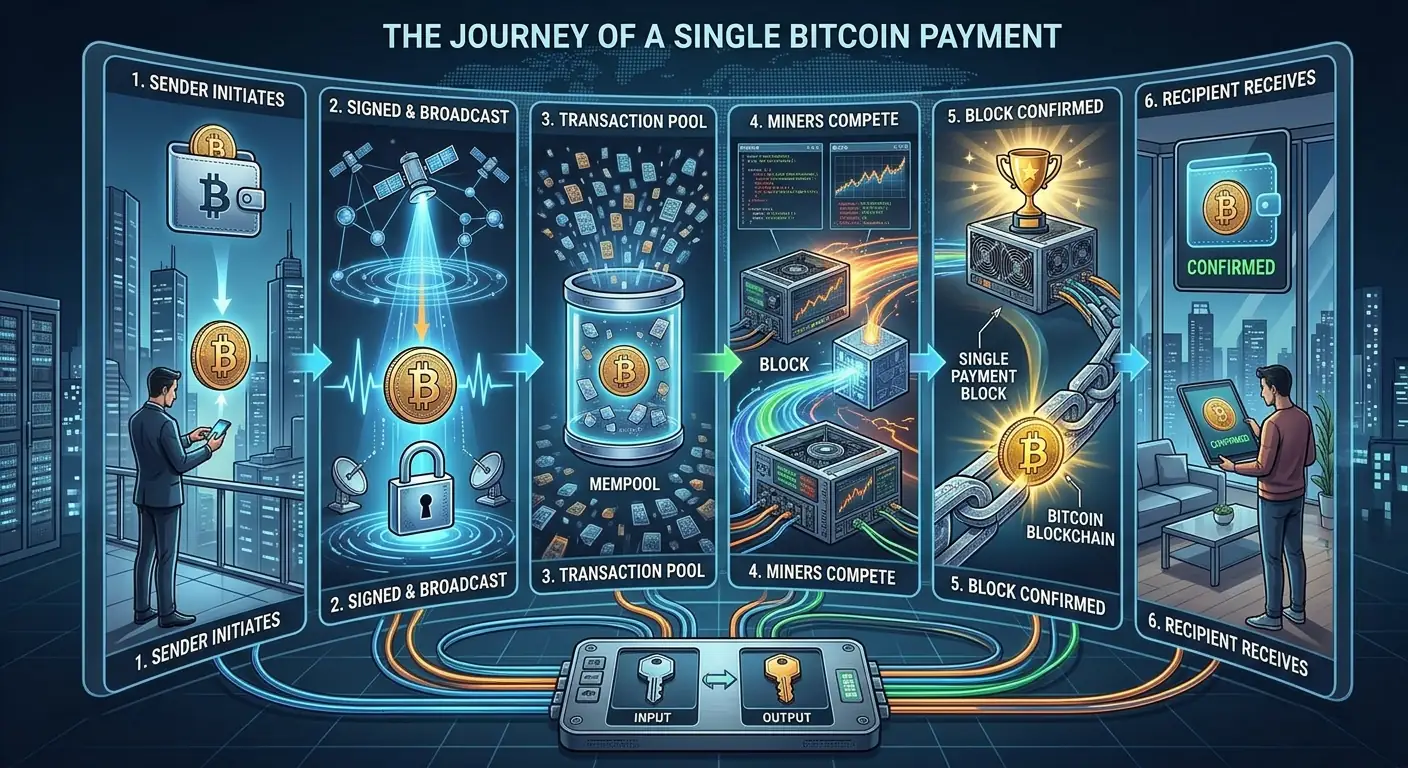
Every time someone sends Bitcoin, the network needs a way to agree that the transaction is valid and decide where it belongs in the blockchain.
There is no central bank or company responsible for approving every payment. Instead, Bitcoin uses a mechanism called Proof of Work (PoW), which allows independent participants to compete to add new blocks of transactions.
This process is known as mining. It requires specialised computers, substantial computing power and electricity.
But why does a digital currency need so much energy? Why can’t Bitcoin simply process transactions without mining?
The answer lies in security. Proof of Work makes it expensive to manipulate the transaction history while allowing anyone to verify the results. To understand why, we need to look at what miners actually do.
1. What is Proof of Work?
Proof of Work is the consensus mechanism Bitcoin uses to agree on the order of transactions.
A consensus mechanism is a set of rules that allows independent computers in a network to reach agreement about which transactions and blocks are valid.
Bitcoin has thousands of participants running software that independently checks the network. These computers are known as nodes.
Nodes verify transactions and blocks according to Bitcoin’s rules. Miners perform an additional task: they compete to create the next block and propose it to the network.
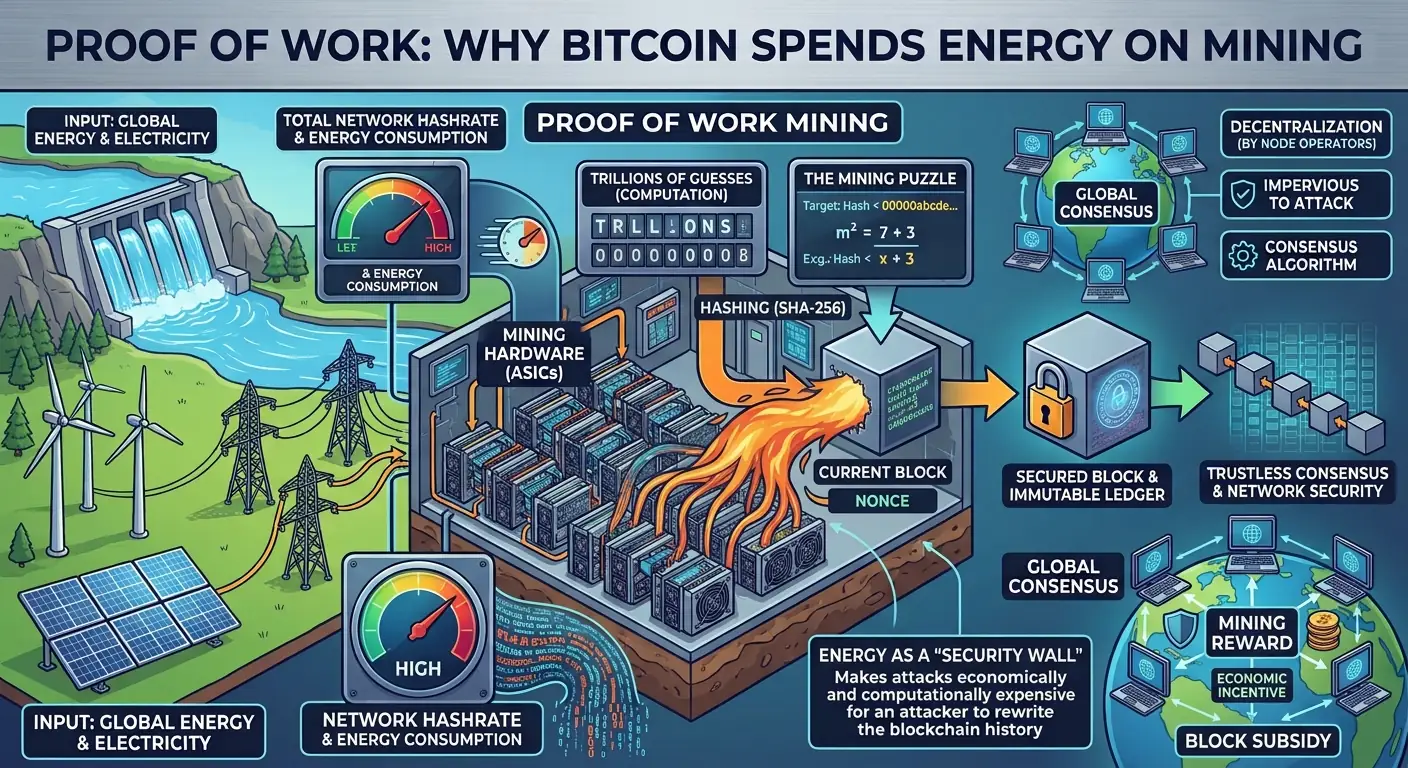
To do this, miners must find a valid cryptographic hash that meets a target established by the network.
Finding that result requires an enormous number of calculations. However, checking whether a proposed result is valid is straightforward.
This difference is essential. Producing a valid block requires computational effort, but verifying it does not require repeating all the work.
That is the basic idea behind Proof of Work: making it expensive to produce blocks while keeping verification accessible to the rest of the network.
2. What does a Bitcoin miner actually do?
Imagine that thousands of people around the world are sending Bitcoin at the same time.
Their transactions are broadcast to the network and shared with nodes. Before they can become part of a confirmed block, they need to be checked against Bitcoin’s rules.
Miners select transactions and assemble them into a candidate block.
A typical block contains:
- A reference to the previous block.
- A summary of the transactions included.
- A timestamp.
- A difficulty target.
- A field called the nonce.
- Other information used to calculate the block header’s hash.
The block header is particularly important because it is the data miners repeatedly process while searching for a valid result.
A miner is not trying to guess someone’s password, break encryption or solve a mathematical puzzle with a hidden answer.
Instead, the miner repeatedly calculates hashes until one meets the network’s difficulty requirement.
3. The role of hashing
Bitcoin uses the SHA-256 cryptographic hash function.
A hash function takes input data and produces an output of a fixed length. Even a small change in the input produces a completely different-looking result.
For example, changing one character in a sentence changes its hash. The output does not reveal the original information, and there is no practical shortcut for predicting which input will produce a particular hash.
In Bitcoin mining, the block header is hashed twice using SHA-256.
The objective is to find a hash numerically lower than or equal to the current target.
A simplified illustration would look like this:
| Attempt | Result | Valid? |
|---|---|---|
| 1 | Hash above target | No |
| 2 | Hash above target | No |
| 3 | Hash above target | No |
| 4 | Hash below target | Yes |
These are illustrative results, not actual Bitcoin block hashes.
If a miner finds a valid hash, it can broadcast the candidate block to the network.
Other nodes can then verify the hash and check that the transactions and block follow the protocol’s rules.
The important distinction is that miners perform repeated calculations to find a valid result, while nodes can verify that result quickly.
4. Why do miners use so much electricity?
The difficulty of finding a valid hash is what creates the energy demand.
There is no known shortcut that allows miners to calculate the correct result directly. They must keep trying different inputs until one produces a hash that meets the target.
Modern mining operations use specialised machines called ASICs (Application-Specific Integrated Circuits).
Unlike ordinary computers, ASICs are designed to perform a very specific task efficiently: calculating hashes for Proof of Work mining.
A single machine can perform an enormous number of calculations every second. Large mining facilities operate many machines simultaneously, consuming electricity to power the equipment and the systems needed to keep it running.
The more computational power a miner contributes, the greater its probability of finding the next valid block.
However, buying more machines does not guarantee a reward. Mining remains a competitive process in which thousands of participants are trying to find the next block.
The electricity is not used to store Bitcoin or move coins from one wallet to another. It powers the repeated calculations required to compete for the right to propose a block.
5. How does Bitcoin control the mining difficulty?
If more miners join the network, the total computational power increases.
Without an adjustment mechanism, this could make blocks arrive much faster than intended.
Bitcoin addresses this through its difficulty adjustment.
The network aims for an average block interval of approximately ten minutes. Every 2,016 blocks, the protocol adjusts the difficulty based on how long the previous group of blocks took to produce.
If blocks were found faster than expected, the difficulty increases. If they were found more slowly, the difficulty decreases.
This does not mean that every block takes exactly ten minutes. Some arrive after a few minutes, while others take considerably longer.
The ten-minute interval is an average target, not a fixed schedule.
This adjustment allows Bitcoin to maintain a relatively predictable block production rate even when the amount of mining power changes.
It also means that adding more machines does not permanently make Bitcoin produce blocks faster. As total hashrate increases, the difficulty can rise to compensate.
6. What does the winning miner receive?
Mining requires investment.
Operators need specialised hardware, electricity, cooling systems, maintenance and, in many cases, access to facilities with competitive energy prices.
To make the activity economically viable, Bitcoin rewards miners who successfully produce valid blocks.
The reward has two components.
Block subsidy
This is the amount of new bitcoin created according to the protocol and assigned to the successful miner. It is the mechanism through which new bitcoins enter circulation.
The subsidy is reduced by half approximately every 210,000 blocks, an event commonly known as the halving.
Bitcoin’s issuance schedule is designed to continue reducing the subsidy until the maximum supply of 21 million BTC is reached.
Transaction fees
Users can attach fees to their transactions to encourage miners to include them in a block.
The miner who successfully produces a block receives the fees from the transactions included in it.
These two components form the block reward.
For miners, the calculation is straightforward in principle: the value of the expected rewards must justify the costs of operating the equipment.
However, profitability depends on several variables, including the Bitcoin price, electricity costs, hardware efficiency, network difficulty and transaction fees.
A rise in Bitcoin’s price does not automatically make every mining operation profitable.
7. How does Proof of Work protect the blockchain?
The energy used by mining is connected to Bitcoin’s security model.
Each block references the previous block through its hash. This creates a chronological chain in which changing an earlier block would also affect the hashes of subsequent blocks.
Imagine someone wants to modify a transaction that was included several blocks ago.
Changing the transaction would alter the block’s contents and invalidate its original Proof of Work. The attacker would then need to produce a valid replacement block and rebuild the subsequent chain.
Meanwhile, honest miners would continue adding blocks to the legitimate chain.
To successfully replace the accepted history, the attacker would need to generate an alternative chain with more accumulated Proof of Work than the honest chain, while also satisfying the network’s consensus rules.
This becomes increasingly difficult as more blocks are added.
The security does not come from making attacks mathematically impossible. It comes from making them economically and computationally expensive.
A successful attack would require substantial resources, and the attacker would still face the possibility that the network rejects blocks that violate its rules.
This is why Proof of Work is often described as a way of connecting the digital transaction history to a real-world cost.
8. What is a 51% attack?
One of the best-known threats to a Proof of Work network is a majority-hashrate attack, commonly called a 51% attack.
If an attacker controls more than half of the network’s total mining power, they may be able to produce an alternative chain faster than the rest of the network.
Under certain conditions, this could allow them to reverse their own recent transactions, potentially enabling double-spending.
For example, an attacker could send Bitcoin to an exchange, receive another asset in return and then attempt to reorganise the blockchain so that the original payment no longer appears in the accepted history.
However, controlling a majority of the hashrate does not give someone unlimited power.
An attacker cannot simply create bitcoin beyond the protocol’s supply rules, spend coins belonging to other people without their keys or make invalid transactions acceptable to fully validating nodes.
The attack primarily threatens transaction ordering and the reliability of recent confirmations.
It would also require enormous computational resources and could have serious economic consequences for the attacker, including damage to confidence in the network.
9. Is Bitcoin’s energy consumption a problem?
Bitcoin mining consumes electricity on a large scale, and its environmental impact is a subject of ongoing debate.
The first thing to understand is that measuring this consumption is not straightforward.
Bitcoin is decentralised, so there is no central authority recording the electricity used by every mining facility.
Researchers therefore estimate energy demand using information such as network hashrate, mining hardware efficiency and assumptions about which machines are economically viable.
The Cambridge Bitcoin Electricity Consumption Index (CBECI), developed by the Cambridge Centre for Alternative Finance, provides estimates and theoretical lower and upper bounds rather than claiming to measure every mining operation directly.
But electricity consumption alone does not tell us the complete environmental story.
The impact also depends on where mining takes place and how the electricity is generated.
A mining facility using electricity from a carbon-intensive grid has a different emissions profile from one using a lower-carbon electricity mix.
There are also questions about energy sourcing, the use of otherwise curtailed electricity, local grid conditions and the environmental cost of manufacturing and replacing mining equipment.
None of these factors makes electricity consumption irrelevant. They show why the debate needs more than a single headline figure.
10. Could Bitcoin work without mining?
Bitcoin could theoretically use a different consensus mechanism, but that would mean changing a fundamental part of its design.
Some blockchain networks use Proof of Stake instead of Proof of Work.
In Proof of Stake, validators commit cryptocurrency to participate in consensus. Their economic stake, rather than a competition based on computing power, is central to the security model.
Ethereum, for example, moved from Proof of Work to Proof of Stake in September 2022.
Both approaches aim to help independent participants agree on the state of a blockchain, but they use different incentives, requirements and security assumptions.
Proof of Work relies on computational effort and the cost of obtaining mining power. Proof of Stake relies on economic commitments and penalties that can affect validators’ staked assets.
Bitcoin continues to use Proof of Work because it is part of the protocol’s original design and its established security model.
Replacing it would require broad agreement and substantial changes to the network’s rules. It is not simply a matter of switching off mining equipment.
11. What happens as the block subsidy gets smaller?
Bitcoin’s mining reward changes over time.
Every halving reduces the block subsidy by 50%. As a result, the amount of new bitcoin distributed to miners becomes progressively smaller.
Transaction fees are expected to play an increasingly important role in miner revenue as the subsidy declines.
This creates an ongoing economic question: will transaction fees provide enough incentive for miners to continue securing the network?
The answer depends on future transaction demand, fee levels, Bitcoin’s market value, mining costs and the amount of computational power participating in the network.
There is no single guaranteed outcome.
The important point is that Bitcoin’s security model includes an economic incentive that changes over time. Understanding mining therefore requires looking not only at electricity and hardware, but also at how miners are paid.
12. Why does Bitcoin spend energy on mining?
Bitcoin mining is not a process designed to produce electricity-intensive calculations for their own sake.
It is the mechanism through which the network makes block production competitive, establishes an order for transactions and attaches a real-world cost to attempts to rewrite its history.
Miners use specialised machines to search for valid hashes. The network adjusts the difficulty to keep block production near its ten-minute target. Successful miners receive a subsidy and transaction fees, while independent nodes verify that every block follows the rules.
The system has a clear trade-off: it provides a way to coordinate a decentralised payment network without relying on a central operator, but it requires substantial computing power and electricity.
Whether that trade-off is worthwhile is a broader question involving security, energy sources, environmental impact and the purpose of the network.
What matters is understanding why the energy is being used. In Bitcoin, electricity is part of the mechanism that makes the transaction history costly to manipulate and straightforward for anyone to verify.
Sources
- Bitcoin.org – Frequently Asked Questions
Explains Proof of Work, mining difficulty, block production and the security of the blockchain. - Bitcoin Developer Guide – Mining
Technical explanation of block construction, mining, hashes, difficulty and the role of miners. - Bitcoin Whitepaper – Satoshi Nakamoto
Original description of Bitcoin’s peer-to-peer design and the Proof of Work mechanism. - Blockstream – Proof of Work
Explains how miners compete to find valid block hashes and how Proof of Work supports Bitcoin’s security. - Cambridge Centre for Alternative Finance – Bitcoin Electricity Consumption Index
Provides estimates of Bitcoin’s electricity demand, mining hardware efficiency and the methodology used to calculate energy consumption. - Cambridge Centre for Alternative Finance – CBECI Methodology
Details the assumptions and limitations involved in estimating Bitcoin’s electricity consumption. - U.S. Energy Information Administration – Tracking Electricity Consumption from Cryptocurrency Mining Operations
Discusses the challenges of measuring cryptocurrency mining electricity consumption and the estimates used to assess it.