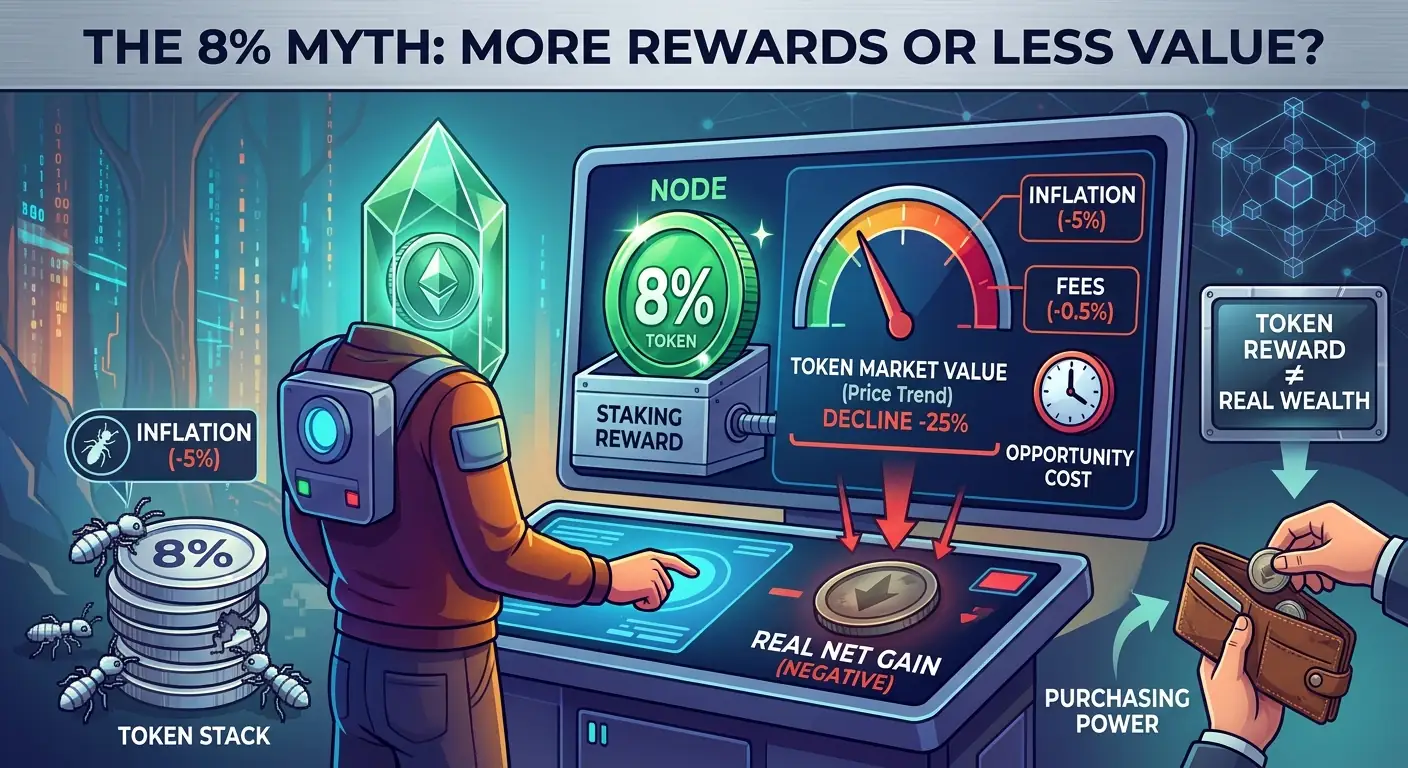
Imagine you own 1 ETH worth $2,000. You decide to stake it because the platform advertises an annual reward of 8%.
A year later, your balance has increased to 1.08 ETH. According to the advertised rate, you have earned exactly what you expected.
But there is one detail you should not overlook: ETH is still a cryptocurrency, and its market price can change.
If ETH falls from $2,000 to $1,500 during that year, your 1.08 ETH will be worth $1,620. You have more ETH than when you started, but your total position is worth $380 less.
This is the difference between earning rewards in a cryptocurrency and making a profit in traditional currency.
Staking can increase the number of tokens you hold, but it does not guarantee that their market value will increase. To understand what an advertised staking return really means, you need to look beyond the percentage.
1. What does staking actually mean?
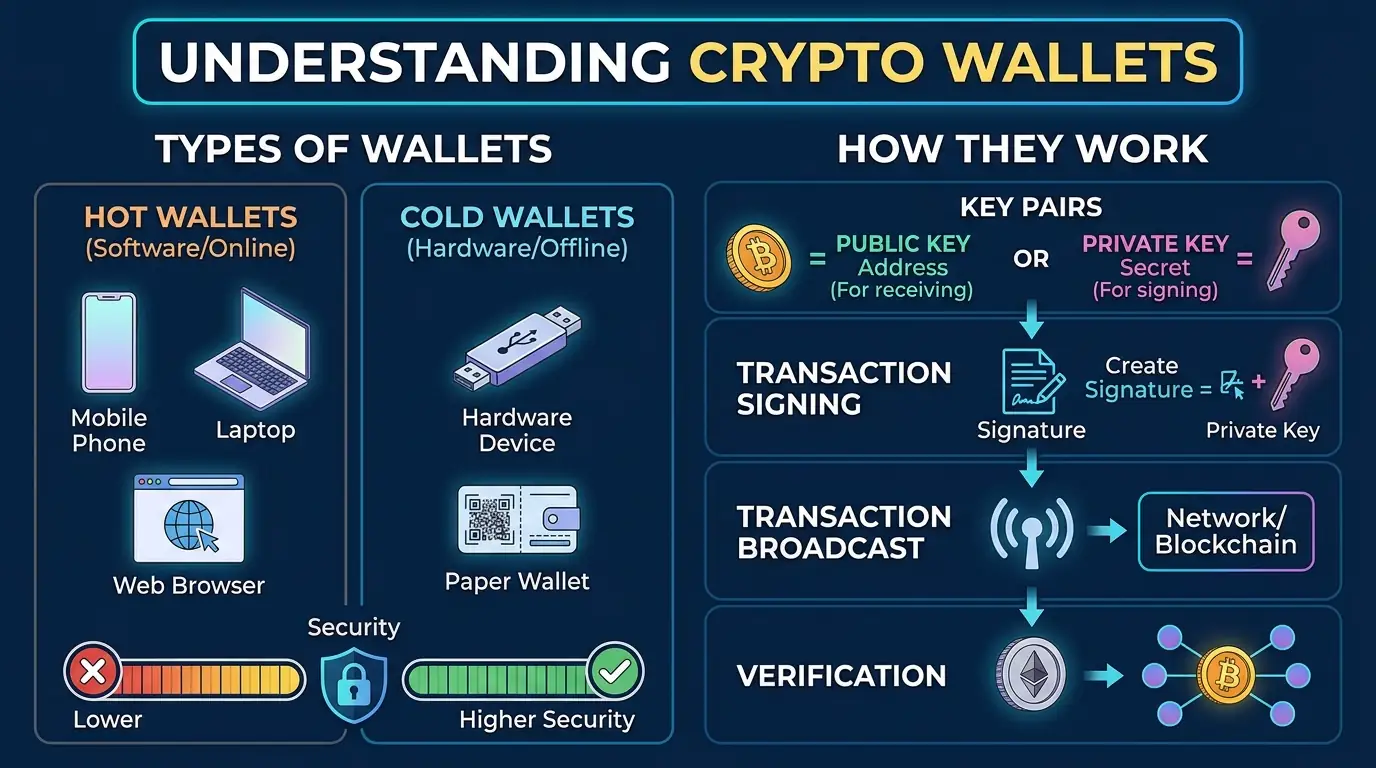
Staking is a mechanism used by Proof of Stake (PoS) blockchains to help secure their networks.
Instead of relying on miners using computing power to validate transactions, Proof of Stake networks use validators that commit cryptocurrency as collateral.
These validators participate in the process of checking transactions, proposing blocks and helping the network reach agreement about which transactions are valid.
In return for performing their duties correctly, validators can receive rewards in the network’s native cryptocurrency.
Ethereum is one of the best-known examples of a Proof of Stake network. Users can stake ETH directly by operating their own validator or participate through staking pools and other services.
The underlying principle is straightforward: participants commit assets to the network, help maintain its operation and receive rewards for following its rules.
However, staking is not always the same experience for every user. The technical requirements, minimum deposits, withdrawal conditions and risks depend on the blockchain and the method used.
2. Where does the 8% reward come from?
An advertised 8% staking return does not necessarily mean that someone is paying you 8% interest.
In a Proof of Stake network, rewards are generally distributed according to the network’s incentive rules. They compensate validators for participating in consensus and performing the required tasks.
Depending on the blockchain, rewards may come from newly issued tokens, transaction fees or other protocol-defined sources.
For example, Ethereum validators receive rewards for activities such as proposing blocks and submitting timely attestations. They can also face penalties if they fail to perform their responsibilities correctly.
The exact reward depends on several factors:
- The total amount of cryptocurrency staked across the network.
- The number of active validators.
- The validator’s performance and availability.
- The network’s reward rules.
- Any fees charged by a staking provider.
An 8% rate shown by an exchange or staking platform may therefore represent an estimate, a temporary promotional rate or a return calculated using particular assumptions.
It should not be treated as a guaranteed payment.
3. More tokens do not necessarily mean more money
Let’s return to the original example.
You start with 1 ETH, worth $2,000, and receive an annual staking reward of 8%.
After one year, assuming the rate remains constant and all rewards are retained, your balance becomes 1.08 ETH.
Now consider three possible market scenarios.
| ETH price after one year | Your balance | Final value |
|---|---|---|
| $2,000 | 1.08 ETH | $2,160 |
| $1,500 | 1.08 ETH | $1,620 |
| $2,500 | 1.08 ETH | $2,700 |
The staking reward is identical in all three scenarios. What changes is the market price of ETH.
If the price stays the same, your position increases in value by 8%.
If the price falls by 25%, your final position is worth $1,620, which represents a 19% loss compared with your original $2,000.
If the price rises by 25%, your position is worth $2,700, producing a 35% increase in value.
The reward adds ETH to your balance, but the market determines how much that ETH is worth.
This is why staking returns should always be considered in two different ways:
Token return: How many additional units of cryptocurrency have you earned?
Market return: How much is your entire position worth in your chosen currency?
Both figures matter, but they answer different questions.
4. What happens when the cryptocurrency loses value?
Cryptocurrency prices can move sharply over short periods.
Staking does not protect users from market volatility. Your staked assets remain exposed to changes in supply, demand, investor sentiment, regulation and broader financial conditions.
Consider another example.
You stake 10 units of a cryptocurrency at $100 each. Your initial position is worth $1,000.
After one year, you have received an 8% reward and now hold 10.8 units.
However, the market price has fallen to $80.
Your final position is worth:
10.8 × $80 = $864.
Despite earning 0.8 additional tokens, your position has lost $136 in market value.
The staking reward has reduced the impact of the price decline, but it has not eliminated it.
This distinction is particularly important when a platform advertises a high percentage. A large reward may look attractive, but it cannot compensate for every possible fall in the underlying cryptocurrency’s price.
5. Inflation can reduce the value of staking rewards
There is another factor that often receives less attention: token inflation.
Some Proof of Stake networks create new tokens as part of their reward system. When new tokens enter circulation, the total supply increases.
This does not automatically mean that the market price will fall. Demand, network usage, token burns and other economic factors also influence the price.
However, issuing new tokens can dilute the ownership share represented by existing tokens.
Imagine a cryptocurrency has a circulating supply of 100 million tokens. You own 1,000 tokens, representing 0.001% of the supply.
If the total supply increases significantly while your balance stays the same, your percentage of the network’s token supply becomes smaller.
Staking rewards can help compensate holders for this dilution, but the result depends on how much new supply is issued and how much of it is distributed to stakers.
For this reason, an 8% staking return should not be evaluated without understanding the token’s monetary policy.
A network with a high reward rate may also have a high rate of new token issuance. Looking only at the reward percentage can therefore give an incomplete picture.
6. APR and APY: why the advertised percentage matters
Staking platforms often display two different measurements: APR and APY.
They are related, but they are not identical.
APR (Annual Percentage Rate) represents an annualised simple return without assuming that rewards are reinvested.
APY (Annual Percentage Yield) includes the effect of compounding, assuming rewards are reinvested at the stated rate and frequency.
For example, an 8% APR with monthly compounding produces an APY of approximately 8.30%, assuming the rate remains constant and all rewards are reinvested.
The difference may seem small, but it becomes more relevant over longer periods.
There is another important detail: the calculation usually assumes that the reward rate remains unchanged.
In real staking environments, rates can vary. The number of validators, network activity and protocol rules can affect the rewards distributed over time.
A platform displaying 8% APY today is not necessarily promising that you will earn 8% over the next twelve months.
Always check whether the figure is historical, estimated, variable or fixed for a specific promotional period.
7. Staking fees can reduce your final return
Not all staking methods distribute the full reward to the user.
If you stake directly by operating your own validator, you may avoid a third-party commission, but you will have hardware, electricity, maintenance and technical responsibilities.
If you use an exchange or staking provider, the service may charge a commission on the rewards generated.
Let’s assume your staking position earns 8% before fees, but the provider keeps 10% of the rewards.
Your effective reward becomes 7.2%, not 8%.
For an initial position of $2,000, assuming the token price remains unchanged:
| Item | Amount |
|---|---|
| Initial position | $2,000 |
| Gross annual reward at 8% | $160 |
| Provider commission (10% of rewards) | -$16 |
| Net reward | $144 |
| Final position value | $2,144 |
This example excludes network fees, taxes and changes in the cryptocurrency’s market price.
The lesson is simple: the advertised rate may not be the amount that reaches your wallet.
Before staking, check how commissions are calculated, whether there are additional charges and whether rewards are distributed automatically or need to be claimed.
8. Can you withdraw your cryptocurrency whenever you want?
Another important consideration is liquidity.
When you stake cryptocurrency, you may not be able to access it immediately.
The withdrawal process depends on the network and the staking method.
In Ethereum, for example, validators can request to exit the validator set. Once the exit process and applicable withdrawal conditions are completed, their remaining balance can be withdrawn.
The time required depends partly on network demand and the withdrawal queue.
Staking through a provider can introduce additional conditions. The platform may have its own processing times, minimum amounts or withdrawal restrictions.
Some services offer liquid staking tokens. These represent a claim associated with staked assets and can be used in other applications while the underlying cryptocurrency remains staked.
This can provide greater flexibility, but it introduces additional risks. Liquid staking tokens can trade above or below the value of the underlying assets, and users may be exposed to smart contract, protocol and liquidity risks.
A liquid staking token is not necessarily equivalent to having the original cryptocurrency available in your wallet.
Before committing funds, understand how withdrawals work and whether you can access your assets when you need them.
9. What can go wrong with staking?
Staking involves several risks that are different from ordinary market volatility.
Validator penalties
Proof of Stake networks can penalise validators that fail to perform their duties.
Minor penalties may apply when validators are offline or miss required activities. More serious misconduct can result in slashing, where part of the staked cryptocurrency is destroyed and the validator is removed from the network.
The exact conditions vary between blockchains.
Provider risk
When staking through an exchange or third-party service, you depend on that provider to manage the operation and handle withdrawals correctly.
If the company experiences financial difficulties, technical problems or security incidents, access to your assets may be affected.
Smart contract risk
Some staking services use smart contracts to manage deposits, rewards and withdrawals.
A vulnerability in those contracts could lead to losses or make funds inaccessible.
Liquidity risk
Even if the underlying network permits withdrawals, a provider or liquid staking market may not offer immediate access to the original assets.
Market risk
The value of the cryptocurrency can fall while your assets are staked. The rewards may not be enough to offset that decline.
These risks should be considered separately. A staking service can operate correctly while the cryptocurrency loses value, or the token price can rise while a technical problem prevents users from withdrawing.
Staking does not remove the risks associated with holding cryptocurrency. It adds another layer of considerations.
10. How should you evaluate an 8% staking offer?
Before choosing a staking service, look beyond the headline percentage.
A useful assessment should include several questions:
What cryptocurrency will you receive as a reward?
If you stake ETH, are rewards paid in ETH or another token? The distinction affects your exposure and the way you evaluate the return.
Is the rate fixed or variable?
A variable rate can change as network conditions evolve. A promotional rate may only apply for a limited period.
What fees will you pay?
Check the provider’s commission, network transaction costs and any additional charges.
How are withdrawals handled?
Understand the unbonding period, exit queue and any restrictions imposed by the service.
Who controls the assets?
Direct staking, pooled staking and exchange-based staking involve different levels of control and responsibility.
What are the technical risks?
If the service relies on smart contracts, liquid staking tokens or third-party validators, identify the additional risks involved.
How is the token’s supply managed?
A high reward rate may be partly explained by new token issuance. Understanding the monetary policy helps put the advertised return into context.
These questions do not eliminate risk, but they help you understand what the percentage actually represents.
11. The real meaning of an 8% staking reward
An 8% staking reward can increase the number of cryptocurrency units you hold. That is what the percentage measures.
It does not guarantee an 8% increase in your purchasing power, your euro balance or your dollar balance.
The final result depends on the token’s market price, network inflation, provider fees, validator performance and the conditions attached to withdrawing your assets.
Staking can be an important part of how Proof of Stake networks operate. It helps secure blockchain systems by giving participants an economic incentive to follow the rules.
But from an investor’s perspective, the reward percentage is only one part of the calculation.
The more useful question is not simply how many tokens you can earn, but what those tokens may be worth after costs, risks and market movements.
Sources
- Ethereum.org – Proof-of-Stake Rewards and Penalties
Explains how validators earn rewards, how penalties are applied and what slashing means. - Ethereum.org – Proof of Stake
Describes the role of validators, staking requirements and the economic incentives behind Ethereum’s consensus mechanism. - Ethereum.org – Staking
Explains different ways to participate in staking, including home staking, staking pools and third-party services. - Ethereum.org – Staking Withdrawals
Describes how validators exit staking, how withdrawals are processed and how withdrawal conditions differ between validator types. - Ethereum Launchpad – Validator FAQs
Provides further information about validator performance, rewards, penalties and the factors that influence staking returns. - Ethereum.org – Proof-of-Stake FAQs
Explains technical aspects of Proof of Stake, validator behaviour and network security.